



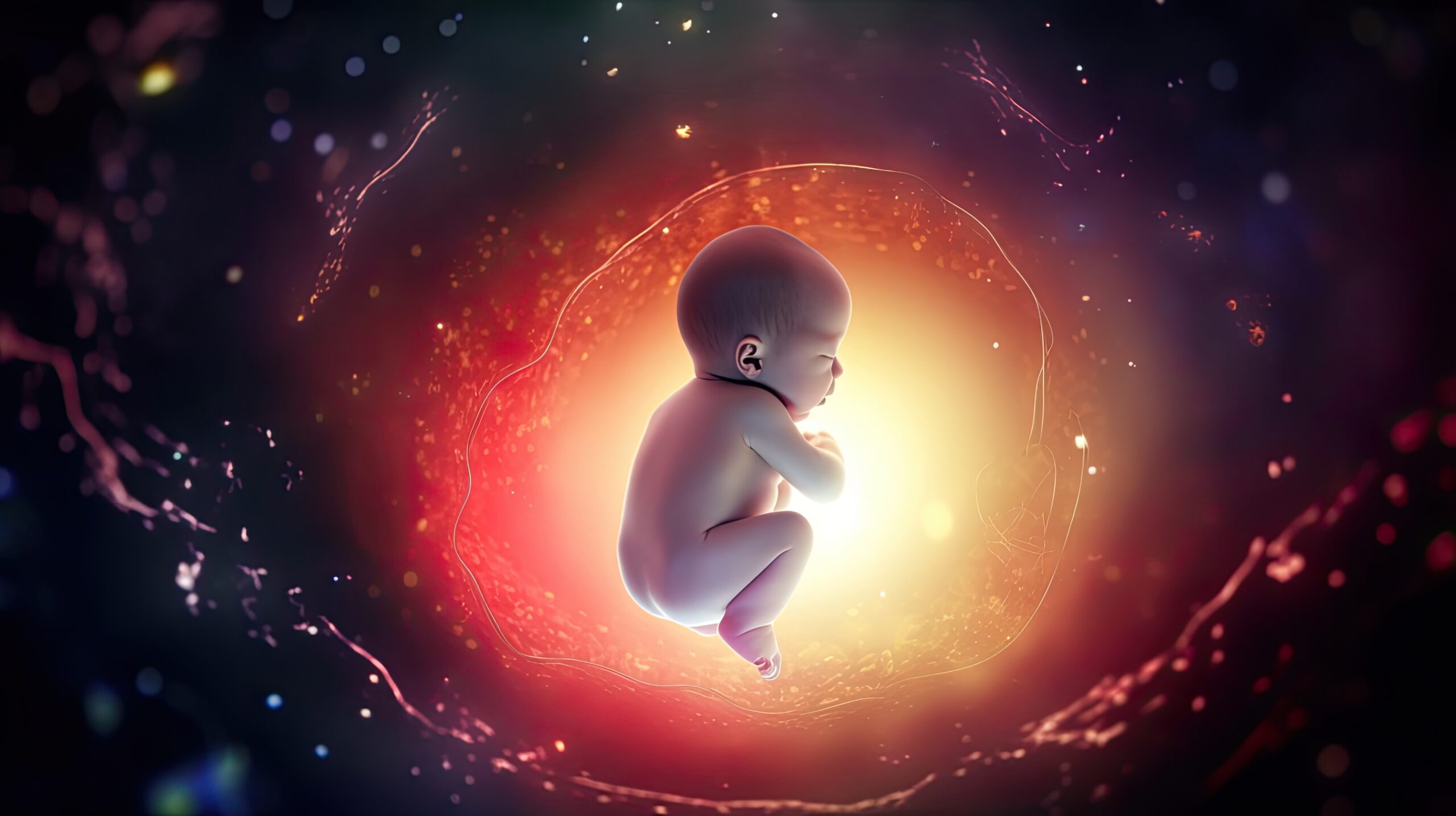
No sense burying the lead. After Bowman points at the Monolith, he becomes a giant floating baby in space. The character is referred to as Star Child. I am not calling him that. Bowman is Space Baby, period. If this is my “the emperor has no clothes moment,” then so be it. The idea of a floating baby with a force field around it is ridiculous. I don’t care that this movie is a classic. I don’t care that Stanley Kubrick made it. This is nonsense.
The ludicrous visual aside, it’s nonsensical from a narrative standpoint. The idea here is that Bowman has become some godlike being. Well, if that’s the case, why would this godlike being choose to look like a naked baby in space? Why would the aliens think it would be a good idea to make this new godlike being’s form a naked baby in space?
I understand that the baby represents rebirth, but this is a prime example of form over substance. Yes. Symbolically Bowman has been reborn, so the baby thing adds up from that perspective. But, narratively, this is another matter. Kubrick gives no explanation whatsoever in the film, but the book does. And since the book is supposed to be an extrapolation of the film, I’m going to use it to infer what’s happening here. According to the book, Bowman still has his memories. He’s still Bowman; at least this is what the book insists—more on that shortly. So, the character, for all intents and purposes, is remaining in some measure as he was. Therefore, he would pick a form that communicates his growth, not regression. He might have wings. He might glow. He might turn into something he thinks looks cool. He isn’t going to return as a baby!
But while the book insists that Bowman is still Bowman, is he really? This returns us to the Übermensch, which I guess in the mind of Clarke takes the form of a petulant child. In the book, this demon baby blows up the world. He unleashes the nukes so he can start over, although he’s not sure what he’s going to replace humanity with. So, Bowman is still Bowman, only now, he lacks a conscience . . . or really anything that might resemble Bowman beyond his memories. It’s at this point in the book that Clarke really gushes on the Monolith, which represents the aliens, Bowman’s benevolent guides.
And I would be foolish to neglect the obvious depopulation narrative going on here. Throughout the book, Clarke is constantly dropping complaints about how there’s too many people. Somebody ought to do something about all that pesky traffic.
To his credit, Kubrick was not stupid enough to add this part to the film. Maybe it was because he’d already put out one movie where everyone blows each other up. Two films with the same ending might’ve marked him as a doomsdayer. The movie ends with the baby staring at the earth, leaving the audience to either wonder what’s going on or what’s going to happen next.
There have been several theories about this ending, particularly the ending with the nukes. People have speculated that there is some theme regarding the cyclical nature of history, or in the movie’s case, evolution. According to a certain pagan view, Eternal Recurrence, history happens in endless cycles. Things must be destroyed and reborn over and over again for eternity. However, when it comes to this explanation of the movie, I think that people are directing their focus onto Kubrick when they should be focusing on Clarke. Kubrick intentionally changed the ending, and I think he did it because he wanted to introduce an optimistic view of humanity’s future after putting out a film that showed humanity’s end. I think his idea was to juxtapose two possible outcomes in his work. Clarke was the one who introduced the nuclear baby idea, and his was an obvious, bordering on propagandistic, depopulation narrative. His idea was that the constant cycle of life and death, which serves as the driving force behind evolution is good and necessary for transcendence. This is an obvious contradiction, given that the whole story is predicated on the idea of mankind overcoming evolution. If mankind is still subject to the endless cycle of life and death, even after transcending, then he really hasn’t overcome anything. Of course, the difference is that, in his scenario, mankind gets to decide life and death rather than being subject to it, which leads to the more insidious moral behind his version of the story: man can become god.
I’m speculating here, but for Kubrick’s part, I don’t think he was so interested in this point. I think, for him, the goal was to show an optimistic scenario where man overcame technology and transcended to a higher plane. He wasn’t so picky about what that plane was, so he tolerated the baby thing. This is just my opinion. I can’t prove it.
The issue is that the competing motivations between Clarke and Kubrick—which the more I think about it, the more convinced I am that this was the case—created a very confusing film with competing ideas. Both men believed in the dichotomous nature of technology. Both men believed aliens could far surpass humanity given enough time, even to the point of reaching a semidivine state. The difference came when they were trying to decide just how godlike these aliens were. Kubrick seemed to see either a demonic or amoral force manipulating mankind, whereas Clarke saw benevolent guides wishing to usher mankind to the next stage of their development. Then there was the outcome of the transcendence. Clarke saw the necessity of the endless cycles of life and death, and, I would argue, wished for it, at least the death part—there’s just too many pesky humans. Kubrick chose to keep the fate of humanity after Bowman’s transcendence open-ended, leaving the conclusion with a possible optimistic alternative. But, once again, his choice to default to the mysterious left the audience with a muddy moral to an already confusing movie. The aliens and the Monolith are evil, but, somehow, mankind, which may or may not be evil, was supposed to rise above the aliens’ machinations and reach godhood with the help of those same aliens and technology, assuming the technology didn’t kill us all. Now, Kubrick is not a stupid filmmaker. He’s widely considered one of the best, but I think he aligned himself with someone who put him in a tight spot, and I suspect he was forced to make compromises that weakened his film’s clarity. I plan to cover my final thoughts on 2001: A Space Odyssey next Saturday.