



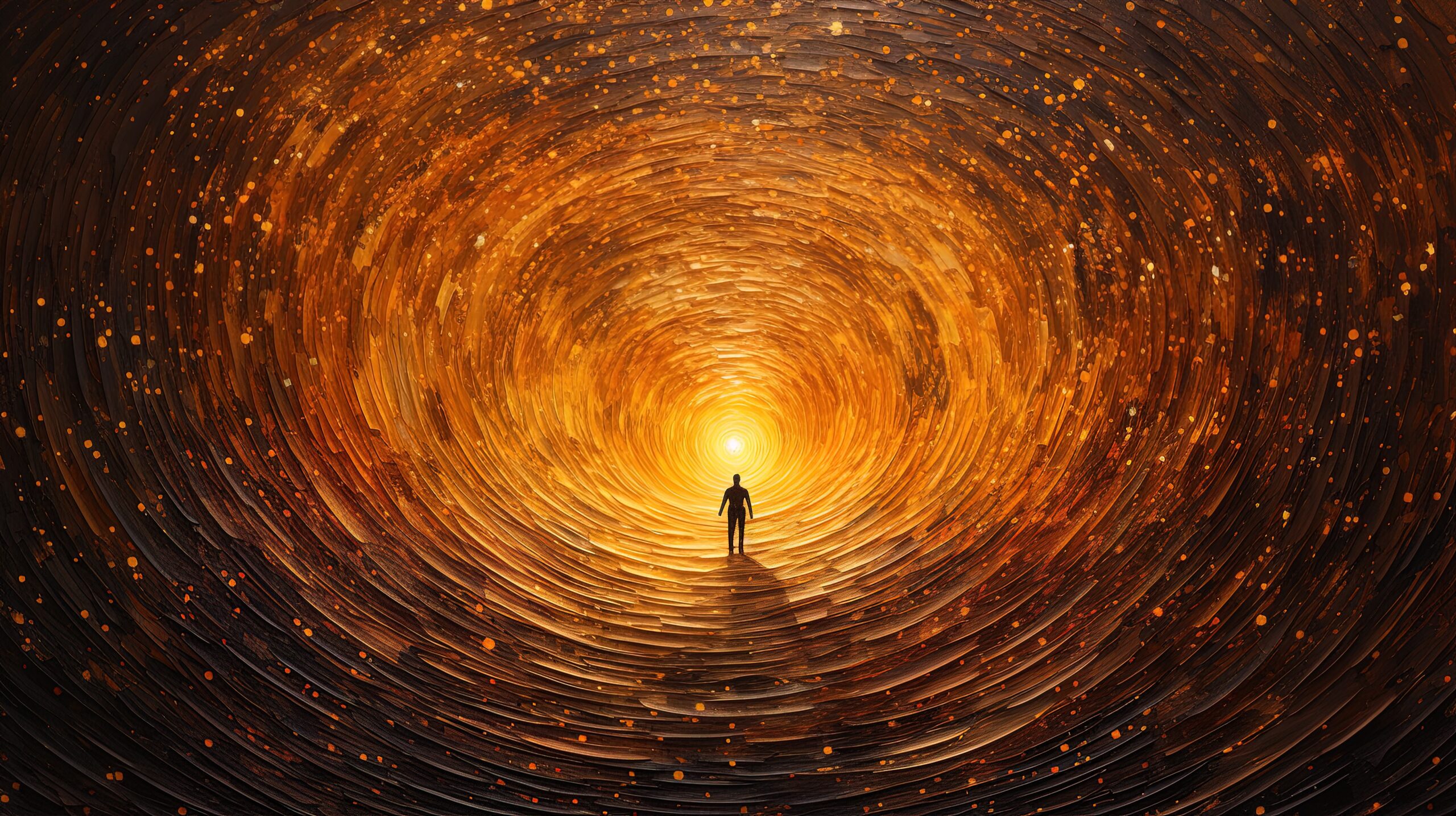
Bowman vs. The Stargate
This is the point where the movie went off the rails. I don’t necessarily mean this as a bad thing because I suspect that Kubrick is trying to thread a needle. He and Clarke seem to be at odds on a key point: the nature of the aliens. The entire stargate sequence is shrouded in an ominous and mysterious vibe, but the sequence ends with benevolent transcendence. At the same time, there is conquering imagery, but Bowman seems to be just along for the ride. Is he a victor for reaching the stargate or has he been caught in a trap? The ideas during this sequence seem to clash, so I think this is another example of Kubrick defaulting to the mysterious as a way to resolve conflicting worldviews with his co-writer. So, I’m hesitant to say this sequence is entirely bad because I feel a certain amount of sympathy for Kubrick. With all that said, let’s begin.
I’ll start by saying that this sequence is entirely too long, and there is no excuse for it from a pacing standpoint. I’m not giving this movie a pass for nearly killing me with almost ten minutes of psychedelic boredom. I swear every color gradient imaginable is used during this sequence. So, that’s my first complaint. This entire thing could’ve been shaved down to a minute, possibly two. What the audience got was entirely unnecessary. I’ve heard that this movie was advertised as a “trip,” and I can see why.
The scene starts with Bowman seeing the Monolith while inside the shuttle, and once the Monolith is aligned with several celestial bodies, he enters a stargate. Other sources and the book had to confirm this for me because all I saw was the camera pan upward after the Monolith faded from view. Then the bizarre colors started. I had to be told I was seeing a stargate. This was not communicated by the film, and I do consider this a fault on Kubrick’s part.
The book did a better job presenting this. The top of the Monolith opened up, and Bowman flew into the stargate. I don’t know if there was a limitation with the technology at the time, but I would’ve preferred this. That or Bowman could’ve chased after the Monolith until the stargate started, or he could’ve approached the Monolith, and it could’ve grown as he neared it until the Monolith covered his entire view, then the colors could’ve arrived. Having the camera pan upward completely threw me off. I had no idea what was happening.
Once Bowman enters the surreal stargate, the audience sees scattered imagery alluding to what’s going on. At one point, the shuttle develops a tail as it rushes through the stargate, making the craft appear to be sperm about to inseminate one of a couple eggs that are represented by distant planets. I have no idea what to make of this; I think it has something to do with man invading the universe, but whatever Kubrick was trying to say, the idea he’s attempting to communicate becomes important later. There is also the appearance of seven diamonds, which show up first as five diamonds, then two more enter the shot as the shuttle continues to move through the stargate. One explanation presented by Jay Dyer is that these seven diamonds represent the gods of the solar system, the gods from which the planets are named. I have no idea if this is what Kubrick was going for, but I have seen other instances where these diamonds appear in his work, and every time they show up, they are associated with something evil. The seven pillows in room 237 and the seven tapestry diamonds that appear around Jack Torrance at a couple points during The Shining are two other examples of this. So, the only thing that I can conclude with any confidence is that the diamonds are evil, more akin to demonic entities. That, or they’re at least amoral. This does line up with Kubrick’s depiction of the Monolith. Unlike Clarke, he doesn’t treat it as something benevolent. I think his view of the Monolith is that it’s something like the tree of the knowledge of good and evil. I don’t agree with this particular twist on the creation story, but I think Kubrick is saying that technology, the knowledge of good and evil, has the potential to make man like God, but there is great peril attached to it. This interpretation seems to line up with his Cold War sentiments.
Once Bowman is through the stargate, he enters a strange room. There seem to be a lot of ideas about what this room represents, but I prefer to rely on Kubrick’s words regarding the subject. He said the room was supposed to be like a zoo. The aliens, who are energy beings at this point, have constructed a room for Bowman to live in, and the reason for the bizarre decorations is that these aliens weren’t exactly sure what a human environment looked like. This is a telling explanation because it again suggests a difference between Kubrick and Clarke regarding what these aliens were. For Kubrick, they seem to be nothing more than a natural step in evolution. For Clarke, they are benevolent guides to transcendence. I’m reiterating this point because I want to stress that I think the reason for some of the chaotic imagery in the stargate sequence goes back to a difference in the writers’ objectives for this film. Kubrick seems to be pushing for a message relevant to the Cold War, which adds up because his previous film was Dr. Strangelove. Clarke seems to be going for something more religious: technology gives mankind the means to become God, and our alien overlords will be there to help once mankind is worthy. I sense that these two ideas are fighting each other, particularly during the stargate sequence, and this might explain some of the confusion.
The other confusing sequence in this film is neat, but I think it adds to the chaos. Kubrick seems to be communicating the passage of time. Kubrick first has Bowman see himself outside the shuttle. Then Bowman becomes that older version of himself outside of the shuttle. Next, he sees an even older version of himself. Then he again becomes that version. This goes on until Bowmen is lying in a bed dying. He points at the Monolith, which is now standing at the foot of his bed. Kubrick said that the aliens basically watched Bowman live out the rest of his life. That was not my impression of the scene, but this isn’t saying much because I was pretty confused. I do need to add a correction, though. In a previous review, I mentioned that Kubrick wanted Bowman to beat the Monolith. I’d heard this from somebody else, and the idea made sense to me because I thought Bowman pointing at the Monolith represented some kind of conflict. But according to Kubrick, the aliens basically captured him and watched him. He was for all intents and purposes a victim of this process, whatever it was, not a victor. Frankly, if this was Kubrick’s idea, it raises a plot hole in my mind because why would the aliens go to all the trouble of capturing a human by contriving some wild goose chase with a Monolith just to watch that human until he died? This isn’t exactly what happens, but what takes place after Bowman points at the Monolith only adds to the insanity, and I plan to cover that next Saturday.