



AMD CEO Lisa Su took the stage at the Advancing AI 2026 conference in San Francisco on July 22-23 to lay out the company’s full AI infrastructure roadmap. The keynote covered everything from current-generation MI455X GPUs to the MI500 arriving in 2027, EPYC Venice server CPUs, and AMD’s annual rackscale system cadence.
MI500: The Biggest Generational Leap
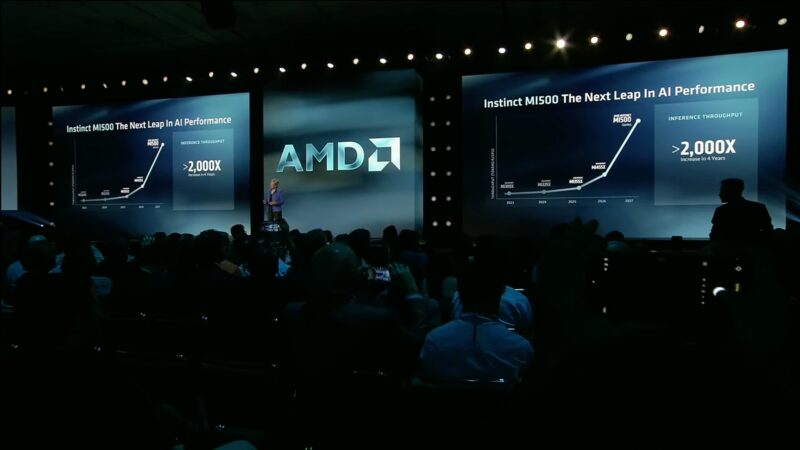
The headline announcement was the MI500 GPU, set to arrive in 2027. Su described it as delivering the largest generational leap in AMD’s accelerator history, claiming a 2,000x performance improvement over four years. The MI500 will be built on CDNA Next architecture, succeeding the MI455X which ships in late 2026.
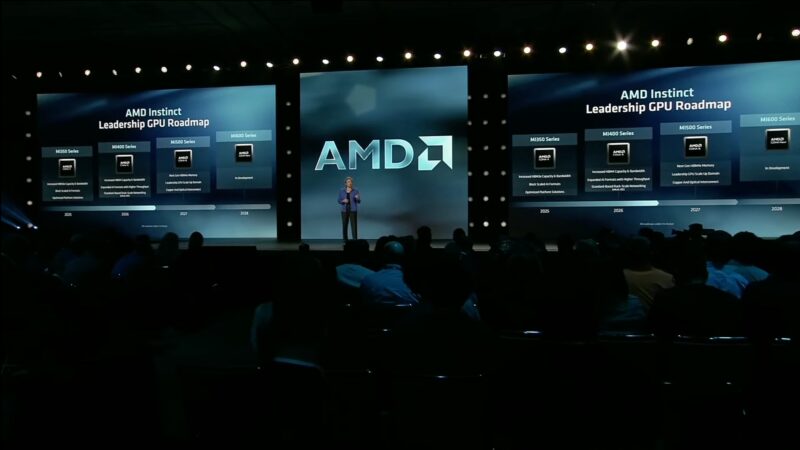
AMD also outlined a new annual cadence for its GPU lineup. The MI600 with a next-generation CDNA architecture is targeted for 2028, followed by further iterations beyond that. The goal is to give data center customers a predictable upgrade path, similar to how Intel and AMD handle CPU generations.
EPYC Venice and the CPU Side
On the CPU front, AMD previewed EPYC Venice, the next-generation server processor line. Venice will follow the current Turin generation and is expected to bring improvements in per-core performance and memory bandwidth for AI workloads. AMD also previewed Florence with Zen 7 architecture for 2028, and confirmed that Rivenna with Zen 8 is under development for 2030.
Su emphasized the x86 ecosystem’s software compatibility advantage over ARM-based alternatives, arguing that customers running existing x86 codebases would face lower migration costs choosing AMD over competing ARM platforms.
Helios Rackscale Infrastructure
AMD introduced Helios, its rackscale AI infrastructure system. Helios combines MI455X GPUs, EPYC Turin CPUs, Pensando DPUs, and the latest ROCm software stack into a unified rack-level platform. AMD plans to deliver a new rackscale system every year, giving customers a complete and predictable infrastructure roadmap.
The ROCm software stack, AMD’s answer to NVIDIA’s CUDA, received a major update. AMD positioned the improvements as closing the gap with CUDA in ease of use and library support, though specific benchmarks were not detailed during the keynote.
Physical AI and Cerebras Partnership
Su also touched on AMD’s physical AI ambitions, introducing the Kria AI SOM (System on Module) designed as a “robotics brain.” Additionally, she highlighted a partnership with Cerebras, calling the company’s wafer-scale chips a source of “tremendous innovation” in the inference market.
AMD’s strategy is to compete not just on raw chip performance but on the breadth of its ecosystem, spanning CPUs, GPUs, DPUs, FPGAs, and embedded processors. The company is betting that customers building AI infrastructure want a single vendor that can supply everything from the server rack to the edge device.
Frequently Asked Questions
When will AMD release the MI500 GPU?
The AMD MI500 GPU is scheduled for 2027. It will be built on the CDNA Next architecture and represents the largest generational leap in AMD’s accelerator lineup.
What is AMD Helios?
Helios is AMD’s rackscale AI infrastructure system that combines MI455X GPUs, EPYC Turin CPUs, Pensando DPUs, and the ROCm software stack into a unified rack-level platform for data centers.
How does AMD ROCm compare to NVIDIA CUDA?
AMD has been investing heavily in closing the gap between ROCm and CUDA in ease of use and library support. The Advancing AI 2026 keynote highlighted significant improvements, though AMD has not published direct benchmark comparisons against CUDA.
What is AMD EPYC Venice?
EPYC Venice is AMD’s next-generation server processor, following the current Turin generation. It targets improved per-core performance and memory bandwidth for AI workloads, with a Zen architecture upgrade.
What is the AMD Kria AI SOM?
The Kria AI SOM is AMD’s System on Module designed for physical AI applications, including robotics. AMD positions it as an all-in-one computing platform for edge AI deployment.
