



This article by Casey Luskin is republished from Science and Culture Today.
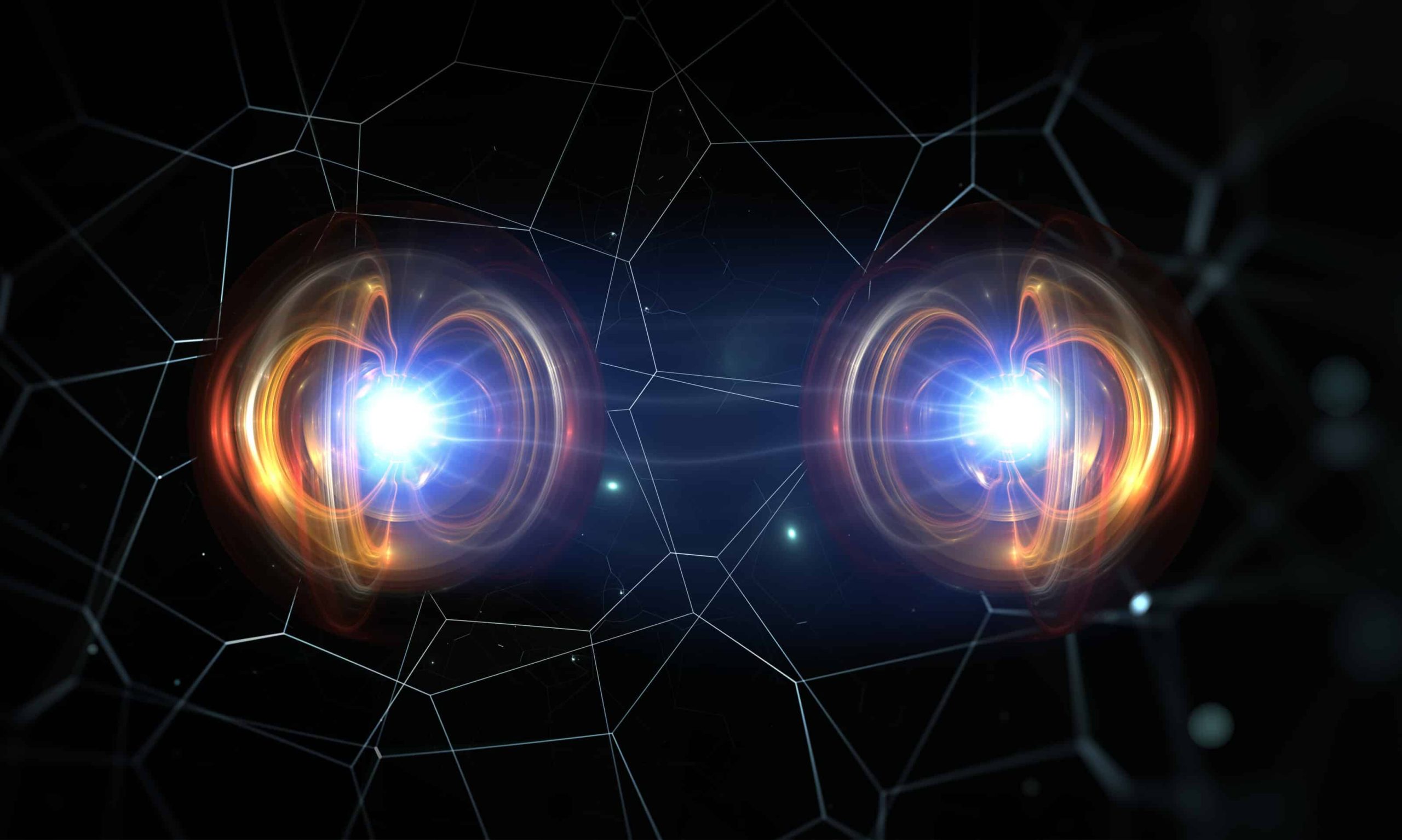
At COSM this week, author Louisa Gilder spoke about her book The Age of Entanglement (2009), about the bizarre quantum mechanics phenomenon where two particles become linked, such that they share the same quantum state. But it gets a lot weirder, because the distance between the two particles doesn’t affect their entangled behavior.
Under entanglement, measuring a property of one particle determines the outcome of the measurement on the other particle. It’s been proposed that the correlation between entangled particles happens instantaneously — certainly faster than the speed of light. Einstein famously called this “spooky action at a distance.” This non-distance-related relationship is called “non-locality.”
Initially, many scientists felt that non-locality or “action at a distance” was too spooky to be correct. They proposed that there were “hidden local variables” that cause particles to behave in the same manner. So quantum entanglement wasn’t actually a thing. If these hidden local variables were real, one could explain entanglement-like behavior deterministically, without there truly being some entangled relationship that arose regardless of the distance between two particles.
This idea of hidden local variables was famously tested in 1972 in the Freedman–Clauser experiment, conducted at Berkeley, which proved that there was no pre-determined, local-variable-governed behavior in quantum particles. Quantum entanglement is real.
Implications for Materialism
But again, it gets weirder. Measuring the state of one particle in an entangled pair destroys the entanglement. All of this has implications for materialism.
First, quantum mechanics shows that the old materialistic conception of a universe composed of billiard-ball-like particles bumping around is wrong. The famous wave-particle duality of matter/energy refutes that model, but certainly so does quantum entanglement, where particles separated by vast distances behave in the same manner through what appears to be an instantaneous link.
Second, quantum entanglement shows that materialistic, mechanistic causation is not enough and you need to be open to other deeper, layers of reality and causality. These implications are precisely why materialistic scientists initially opposed the reality of entanglement and believed (wrongly) there were alternative “hidden local variable” explanations. Does this point to unseen dimensions or deeper realities, even immaterial ones?
Some even go so far as to suggest that quantum mechanics reveals that consciousness is a fundamental part of the fabric of reality, and conscious attention upon parts of nature has real effects on how the universe operates. Matter and energy are everywhere, but they aren’t everything. There is also mind.
Life Is Complicated
Louisa Gilder would presumably agree. Commenting on entanglement, she remarked that “The world is so much more mysterious than what we just see.”
Gilder closed by quoting the famous mathematician and physicist John von Neumann who said, “If people do not believe that mathematics is simple, it’s only because they do not understand how complicated life is.” That’s a true statement, if not an understatement — the more we study life the more complicated it turns out to be.
Yet also mysteriously, the behavior of nature is elegantly described by mathematics — by what was famously called by the Nobel Prize winning theoretical physicist and mathematician Eugene Wigner, “The Unreasonable Effectiveness of Mathematics.” As he put it: “the enormous usefulness of mathematics in the natural sciences is something bordering on the mysterious and … there is no rational explanation for it “
If these points don’t reveal intelligent design in nature, what does?
Editor’s note: For more on scientific evidence of an immaterial reality, from neuroscience and genetics respectively, see recent books by Michael Egnor and Denyse O’Leary, The Immortal Mind, and by David Klinghoffer, Plato’s Revenge.