



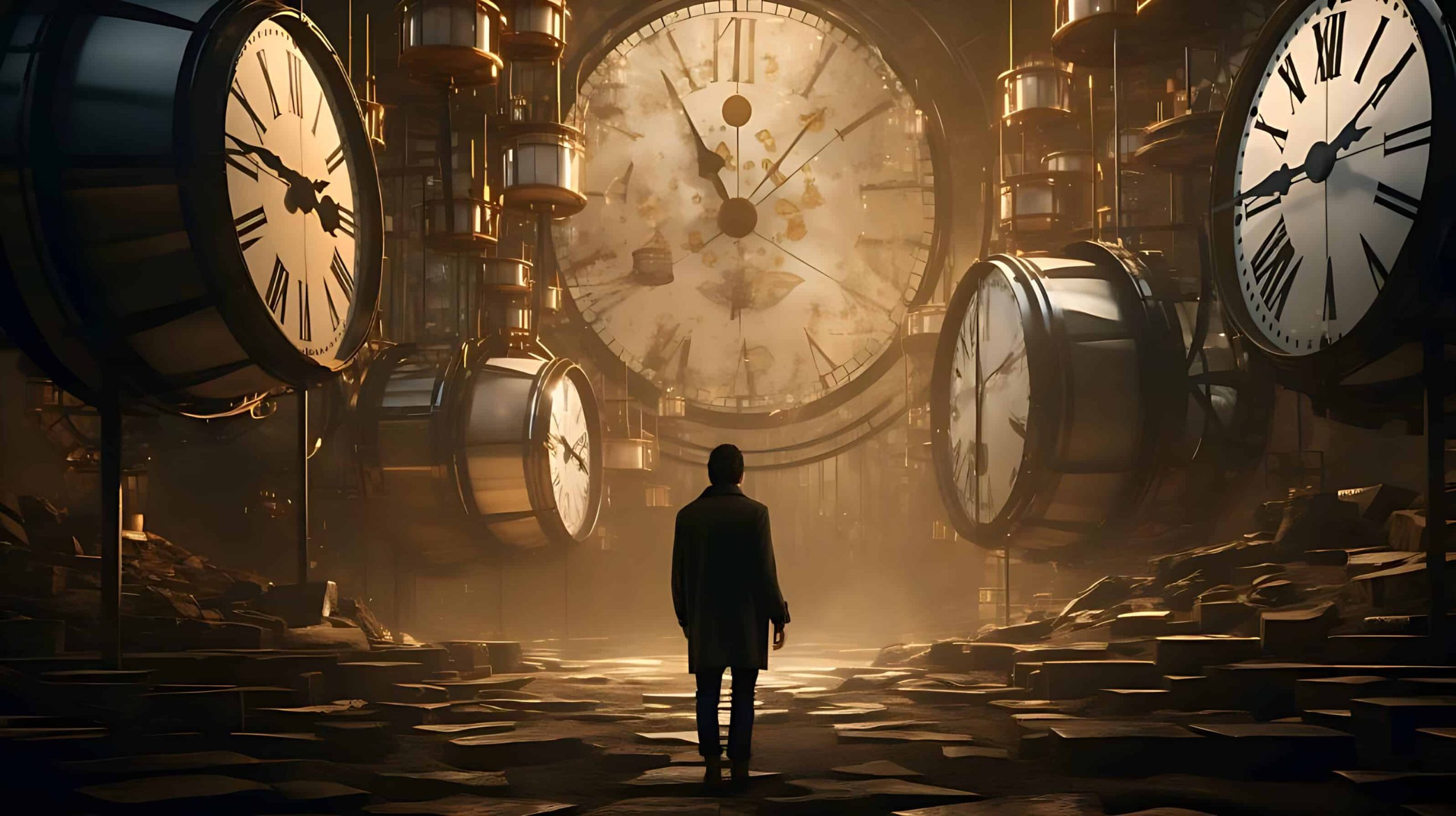
Last Saturday, I began laying out a plot for a time-travel story that hangs together and began describing the mechanics of the machine. I chose to treat the time machine as a hard magic system while keeping time itself as a soft magic system. The story premise is that a man is using the machine to explore the past. Sitting inside it, he is surrounded by a small force field, so he can observe the past (soft magic) without the risk of altering anything (hard magic, which imposes rules). Thus he cannot trigger the disastrous butterfly effect.
Developing a story problem
So, now that the machine and the character have been set up, what is the story problem? Perhaps this machine is experimental, and our character is testing it on himself in case there are glitches. Conscience prevents him from trying it on anyone else first. But when he realizes it works, he gets excited and tells his wife.
So what’s the problem? Well, how about this: his wife was a widow when he married her. She decides to go back into the past to watch her interactions with her first husband. She does this several times and she doesn’t tell her second husband, the time machine inventor.
But as both of them continue to use the machine, she slowly realizes that they are beginning to forget things. It’s subtle at first, but it’s clear the machine is doing something to their minds. Still, she keeps returning to the past to see her first husband. She can’t help herself because she still loves him.
Then, one day, she gives in to temptation. She knows she shouldn’t step outside the force field. She knows anything could happen. But she still looks much like her younger self, so she decides to take the risk. She steps into the unknown. She even crushes a butterfly on her way to see him…
She meets and talks to her first husband, and during that conversation, she accidentally says something that prompts him to change his plans. As a result, he avoids the crash that was supposed to kill him.
And the problem is…
When she comes back to the present, at first everything seems fine. The butterfly she killed didn’t affect anything at all. However, she does have a splitting headache, and she’s more forgetful than usual. To make matters worse, after she leaves her second husband’s lab and returns to their home, she sees her first husband sitting at the kitchen table. They’re still married.
She returns to the lab. There she discovers that her second husband has a completely different home. She finds him. He still remembers her and is still using the machine. She tells him what happened, but as she attempts to recount what she said to her first husband, she can’t remember the words she used. It doesn’t matter anyway because the second husband has already figured out what she’s done and is furious with her.
He decides to keep using the machine, hoping to forget about her. He’s been aware of the memory issue associated with it for a while. But what he didn’t know was that she too was using the machine.
Story decisions, decisions!
Does the wife let her second husband continue using the machine, even though there’s no telling the damage it will do? Does she destroy the machine? Or does she go back into the past and undo what she did, even if it kills her first husband, and even if she can’t remember what she’d said? And what about the version of her who violated the safety rules by leaving the machine to talk to her first husband? Will she believe her tale? Or would that other version of her even care because she doesn’t realize how much she loves her second husband? What if that other version wants to keep existing? And to make things more complicated, the damage she’s done to her mind is far more extensive than she had realized, thanks to the alternate reality she’s created. If she travels back again, will she even remember why she’s back there?
A specific change to the time travel story rules
So, that’s my time travel story. If it is similar to someone else’s, I haven’t seen it. Last Saturday, I mentioned that I was going to do something specific with the story rules. Now that the plot is constructed, let me explain.
I am using the rules to narrow the focus of the plot, not to escalate the situation. Escalation is where the Terminator franchise went wrong. The writers kept treating the rules like new elements in the story and enlarging their world until it became contradictory. By using the rules to limit the scope of the story, I can direct the reader’s attention to only the relevant elements of the plot. The time machine rules keep paradoxes from being the focus of the plot — with one specific and intentional exception. Technically, the first husband’s return could be considered a paradox, but it’s meant to be a twist. It’s supposed to act as a gut punch for the wife who believes that crushing the butterfly didn’t do anything.
How was this twist constructed?
The hard magic system represented by the time machine is meant to establish a sense of security because all the variables are supposed to be accounted for. The soft magic system of time is supposed to represent the threat of the unknown. Thus the wife senses she is doing wrong because she is, metaphorically speaking, leaving the trail and traveling deeper into the forest. She takes the risk, has an anxious moment with the butterfly but thinks all is well —until she sees her first husband sitting at the kitchen table. The butterfly, which could be foreshadowing, serves to lull her into a false sense of security. But once she’s back at her house, she realizes the truth: her sin has had a consequence.
From this point on, other rules serve to complicate her world and agitate her emotional state. I’m using the machine to create a ticking clock around the memory loss issue. That serves to explain why this time machine will never reach the public. That in turn creates more anguish for the second husband and helps account for why he wants to forget about his wife and his life with her.
One thing I make a point of not doing is adding external elements to broaden the plot. Every rule forces the reader to focus on the character more and more. One way to think about it is that the rules are a sort of microscope; with additional detail, the lens zooms in more and more on the characters. Things become more focused, not less.
Have I missed something? Probably. My only defense is that I made this plot up on the fly, and I can’t stress enough how much I hate time travel as a story premise in general! Hopefully, any storytellers out there who read this series will find my reflections useful.
Here are the five earlier essays on my series on time travel in science fiction. They are also interlinked:
The pluses and the perils of time travel in science fiction. Time travel can be treated as a form or hard or soft “magic” but it is important not to confuse the two. Soft magic is vague and incidental; hard magic imposes rules on the story. Too often in science fiction, these rules get broken.
Time travel: How and why the Terminator series worked — then didn’t Part 2: Time travel works well enough as a soft magic system but time-travel stories run into problems when it is treated as a hard magic system. Terminator 3 crossed into hard magic territory when it added the concept of fate to time travel, which means that specific rules began to matter.
Time Travel: The threat of escalation in the Terminator series. Part 3: The Terminator series writers never new whether there would be a sequel, and that had implications for how they plotted time travel. Shrouding the story rules in mystery only works with soft magic systems where the story focus is on something other than the system.
Now for some examples that work… Here in Part 4, we look at how to make time travel work as either soft or hard magic. Time travel into the future is not as tricky as travel into the past because altering the future does not create so many complex story problems.
and
How to write a time travel story that keeps making sense, Part 1. Here in Part 5 of the series, I offer an approach that allows for time travel without obvious giant plot holes. To keep the story under control, the time machine itself should be a hard system even if the concept of time is soft and pliable.