



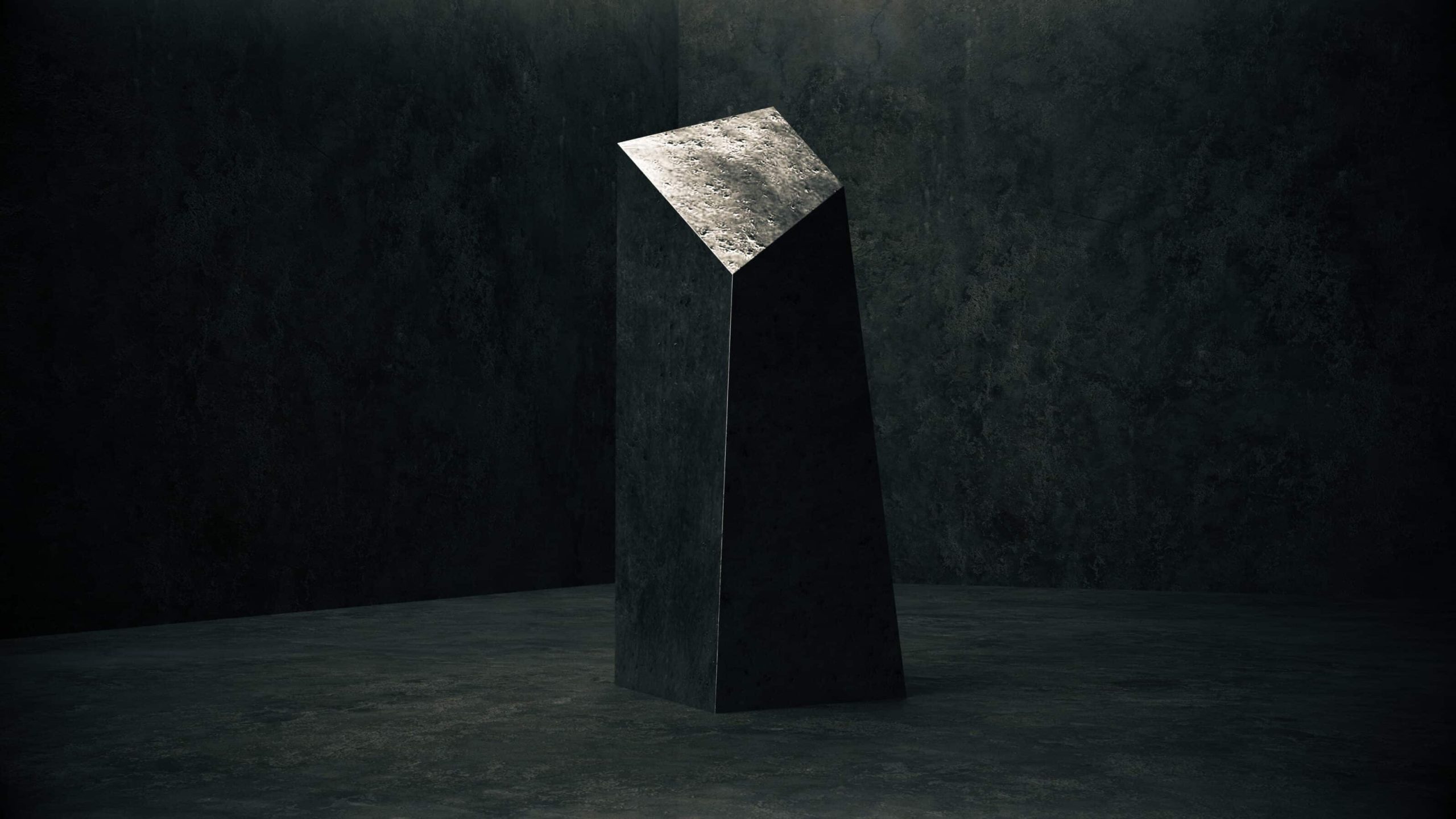
Earlier in the production of the film 2001: A Space Odyssey (1968), the idea of putting a screen on the Monolith was floated and quickly rejected. In the book 2001: A Space Odyssey which was written alongside the film, the ape-men are literally possessed by the Monolith and compelled to perform various tasks. But director Kubrick chose to keep things subtle and open-ended instead. This was a good choice because to do otherwise would’ve required additional exposition.
So, why the Monolith?
It’s hard to know what to make of the explanation that the book offers. To me, the movie was so ambiguous, yet broad in scale, that the explanation presented was in line with my expectations. But how believable is it?
Basically, aliens are conducting an experiment. They are essentially reprogramming the ape-men in the hopes of making them more advanced in the future. This scenario certainly lines up with everything presented in the film, but I felt that the book, which articulated the idea, failed to sell it.
And what about the original author, Arthur C. Clarke?
I have found Arthur C. Clarke (1917‒2008) — differences in beliefs aside — to be a fascinating writer. Before preparing for this review, I’d never read any of his work. But in terms of pacing, he kept my attention. I remained interested in both “The Sentinel” — the short story on which 2001: A Space Odyssey is based— and the film adaptation and the novel. In fact, I’d say his pacing is far better than H.G. Wells’s. I’d argue Clarke surpassed the author who inspired him in this respect.
However, Clarke failed to offer a convincing reason behind the aliens’ experiment. Why did they want to make other species more advanced? To the extent that the accompanying book explains their reasoning, the explanation is cursory. The motivations for the various characters in the story are not well explored, and, by the end of the novel, this lack of clarity is very noticeable, particularly with the famous space baby sequence — but more on that later.
Why the film opts for mystery
I think the aliens’ unclear motives put Kubrick in a tough spot. Showing the aliens would’ve demanded answers to questions that are not resolved in the book. So, Kubrick was, in some measure, forced to lean on mystery in the film.
For example, to show the Monolith’s extraterrestrial origins would’ve required giving the aliens a backstory, chewing up a lot of valuable screen time for a group of characters that never even appear. In the book, these creatures literally become elements — fire, water, energy, and such, except that they have consciousnesses — by the time Bowman appears. For Kubrick, there would’ve been no point in explaining all of this onscreen.
How well did it work?
So, the main question for Kubrick was how to communicate that the Monolith was giving the ape-men information. Sadly, I don’t think Kubrick did a great job conveying what was happening. All the audience really sees after the ape-men encounter the Monolith is this: the main ape-man, called Moonwatcher in the novel, remembers seeing the Monolith, then begin swinging a bone around, realizing he can use it as a weapon.
When it comes to what information the Monolith was conveying, the novel’s explanation is straightforward, but I’m not sure what Kubrick had in mind. Did the Monolith directly tell Moonwatcher to use the bone as a weapon? Did the mere sight of a manufactured object suggest to the ape-men that matter could be manipulated. Did this revelation inspire Moonwatcher to use the bone as a weapon?
The movie never says, and Kubrick’s choice to lean on the mysterious when it comes to this subject bothers me because the explanation would’ve revealed to the audience more about the stakes of the story. If the Monolith told Moonwatcher to use the bone as a weapon, then that suggests something about the nature of the Monolith. It becomes a malevolent force that corrupts mankind, a serpent of sorts. If the Monolith was meant to demonstrate the idea of manipulated matter and Moonwatcher was the one who decided to use the bone as a weapon, then evil is in the heart of man from the beginning. The exact role of the Monolith in humanity’s origins determines whether or not the Monolith is supposed to be seen as a symbol for salvation or damnation.
Again, I understand the appeal of leaning on mystery, but, in my opinion, to be mysterious on this point muddies the stakes. A single shot of the Monolith aligned with the sun and moon was not enough.
Might a difference in worldviews underlie the problem?
I suspect that more was going on here than Stanley Kubrick (1928‒1999) simply defaulting to the mysterious to avoid answering questions. Given the different endings in the novel and the film and Clarke’s explanation of the Monolith’s actions and origins in the novel, I think Kubrick and Clarke had a fundamental difference in worldviews. I’ll explore this in more detail while reviewing the ending of the film. But for now I think this difference in worldviews presented Kubrick with yet another problem.
Kubrick couldn’t directly conflict with Clarke because they were working together on the story. But at the same time, I think Kubrick saw the Monolith as a malevolent force, whereas Clarke saw it as a means to transcendence. I don’t think the ambiguity in 2001 is the result of artistic muddiness. I think it was the middle ground for an unspoken conflict between the two writers.
Kubrick answered as few questions as possible regarding the Monolith, knowing that Clarke, in some measure, approved of the Monolith’s actions in the book, accepting the use of technology and weaponry as a necessary evil on the way to transcending survival of the fittest.
His anxiety over the Cold War had dampened his optimism. He felt that mankind’s technology had put it on the path to almost certain annihilation. In his mind, this whole mess was the Monolith’s fault. I think this also accounts for the way the film’s ending was shot. It too is wildly different from the book. I suspect that Kubrick wanted Bowman to, somehow, defeat the Monolith, and that victory was what led to his transcendence. But in the book, Clarke portrayed the Monolith as a benevolent guide.
Letting the audience decide
By having a single shot of the Monolith cut between Moonwatcher’s discovery of the bone, Kubrick was letting the audience decide the Monolith’s role, which was probably his safest option. The rest of the Dawn of Man sequence is simple enough. Moonwatcher kills the head of a rival tribe, securing the watering hole. Then a bone is thrown into the air, and there is a jump cut to a spaceship, connecting the bone to technology.
Another piece of evidence
I haven’t confirmed that this conflict between Kubrick and Clarke existed, but my theory is the best explanation for the differences between the film and the book. And there is one other piece of evidence that doesn’t prove anything, but is in my view suggestive, so I’ll mention it here.
During the introduction of the novel, Clarke reads from his journal. He states with some amusement that he recommended H.G. Wells’s 1936 film “Things to Come” to Kubrick. Kubrick hated the film…
We’ll look at the second act of 2001: A Space Odyssey next Saturday.
Here’s the first part of my review: 2001: A Space Odyssey was a new type of science fiction, The film is perhaps best understood as three completely different stories whose only connection is the monolith. The greatest measure of a film’s success is the test of time. Something about this film works even though it breaks conventions.
Here’s the second: Space Odyssey 2001: Decisions to make about that Monolith. In Part 2 of my series on the sci-fi great, I want to consider where the Monolith fits in the hard vs. soft magic systems that make for sci-fi stories. Letting the question of who sent the monolith remain a mystery was probably a wise dramatic choice on the part of the writers.