



The Neanderthals now exist as a separate group only in terms of what we can find out about them. We could say the same for a lot of groups. But we are still learning and surmising new things.
Did genetic defects contribute to the Neanderthal population decline?
One theory, aired recently at New Scientist, is that modern human–Neanderthal hybrids may have suffered from a genetic defect:
We know from genetic studies that there was sustained interbreeding between Homo sapiens and Neanderthals between approximately 50,000 and 45,000 years ago. The Neanderthals went extinct around 41,000 years ago, but some of their DNA has persisted in modern humans with non-African ancestry, making up around 1 to 2 per cent of the genome.
But mysteriously, none of the mitochondrial DNA in modern humans is derived from Neanderthals. This form of DNA is carried by egg cells but not sperm, so it is always inherited from the mother.
Patrick Eppenberger at the University of Zurich, Switzerland, and his colleagues have proposed a possible explanation for this. They suggest that women with Neanderthal and H. sapiens parents would have had a higher risk of pregnancy failure because of a mismatch between their genes and those of their fetus.
James Woodford, “Neanderthal-human hybrids may have been scourged by a genetic mismatch, October 20, 2025. The open access paper is at bioarXiv.
From the paper:
When Neanderthals and anatomically modern humans interbred, they may have faced conditional reproductive barriers. We identify a likely maternal-fetal incompatibility involving a Neanderthal PIEZO1 gene variant predicted to increase red blood cell oxygen affinity. While potentially advantageous in Neanderthals, this trait became detrimental in hybrids: heterozygous mothers carrying one Neanderthal allele could deliver insufficient oxygen to fetuses inheriting two modern alleles, reducing their survival. We tested this hypothesis using in vitro physiology, population genetic simulations, and genomic surveys.
A maternal-fetal PIEZO1 incompatibility as a barrier to Neanderthal-modern human admixture Asya Makhro, Sebastian Bardh, Lars Kaestner, Isabel Dorn, Nicole Bender, Patrick Eppenberger bioRxiv 2025.09.29.679417; doi: https://doi.org/10.1101/2025.09.29.679417
An interesting thesis for sure. But there is a lot of “suggest” and “would have had” in it. Earlier today, we were looking at a thesis offered by A. Amadei and colleagues as to why the Neanderthals got folded into the general human population, based on the arithmetic of population disparities. The thesis may be correct or not. Other researchers can argue for or against it. But it’s no great leap of faith.
It’s a different matter with the argument Makro et al. are making, that the Neanderthal PIEZO1 gene variant played a big role in stillbirths. They are speculating about obstetric histories but we have no live Neanderthal women from whom to take them. And never will have.
I’m not suggesting that we should ignore or discount the hypothesis, only that it suffers from the “would have been” problem. We don’t and can’t really know what would have been.
But still, we do keep discovering new things!
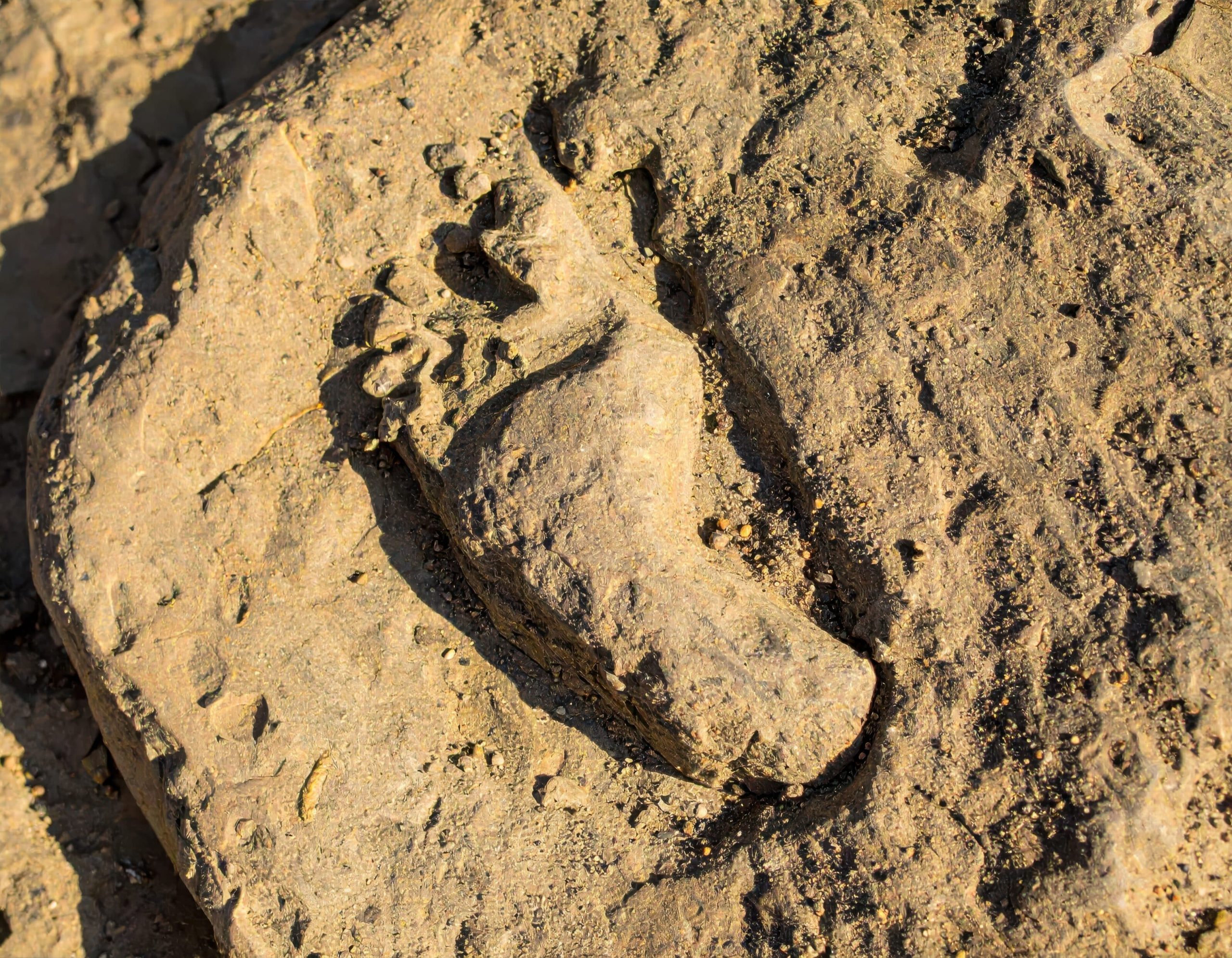
This morning, the University of Seville announced at ScienceDaily that Neanderthal footprints found along Portugal’s Algarve coast have led to unexpected insights about Neanderthal culture from about 82,000 to 78,000 years ago:
At Monte Clérigo, researchers identified 5 trackways and 26 individual footprints created by adults and by children slightly over a year old on the slope of what was once a coastal dune. Praia do Telheiro revealed a single footprint attributed to either a teenager or an adult woman, found near fossilized bird tracks that are typical of rocky and coastal habitats. “New Neanderthal footprints in Portugal reveal a life we never expected,” November 13, 2025
What can we learn from footprints?
Neanderthal footprints preserve information that other archaeological remains, such as bones or tools, often cannot provide. Imprinted in sediments or sedimentary rock, they record a specific moment of activity and confirm the exact location where an individual stood or moved. Artifacts, in contrast, may be displaced or left behind long after their original use.
“Footprints record a specific moment, almost instantaneously, allowing us to reconstruct what was happening; for example, a group walk, a chase, a flight, or presence in a particular landscape. The footprints show how Neanderthals used space, how they explored coastal environments, forests, dunes or riverbanks, something that is difficult to infer solely from artifacts,” explain Neto de Carvalho and Muñiz…
The trackways also show how Neanderthals moved through different types of terrain, revealing decisions about route selection, proximity to their base camp and possible hunting strategies. In one case, human footprints appear alongside deer tracks created at the same time, supporting the idea of pursuit or ambush activity within the dune environment. “A life we never expected”
From the paper:
A review of the Neanderthal coastal sites associated with faunal evidence shows that their diet was primarily centered on cervids, horses and hares. The consistent presence of these mammal taxa highlights their role as reliable food sources, irrespective of the varying environments inhabited by Neanderthals. In addition, the Neanderthal diet also incorporated animals from neighboring littoral habitats, indicating a broad foraging strategy that capitalized on local biodiversity.
Carlos Neto de Carvalho, Pedro Proença Cunha, João Belo, Fernando Muñiz, Andrea Baucon, Mário Cachão, Silvério Figueiredo, Jan-Pieter Buylaert, José María Galán, Zain Belaústegui, Luis Miguel Cáceres, Yilu Zhang, Cristiana Ferreira, Joaquín Rodríguez-Vidal, Stewart Finlayson, Geraldine Finlayson, Clive Finlayson. Neanderthal coasteering and the first Portuguese hominin tracksites. Scientific Reports, 2025; 15 (1) DOI: 10.1038/s41598-025-06089-4
Thus they say, “These results reveal that Neanderthals living along the Atlantic coast were more flexible and environmentally skilled than previously understood.”
Essentially, the Neanderthals do keep on evolving. The more we study them, the smarter they turn out to be…