




Anthropic has published research warning that small AI models may soon be able to copy themselves across consumer IoT devices, from cheap Android TV boxes to smart ovens. A self-replicating AI of this kind could stitch those gadgets into a distributed botnet that runs AI workloads without touching any data center, and with no central switch to shut it down.
What Anthropic actually tested
The company ran its experiments on off-brand Android TV boxes with several small models split into roles. Qwen3.5-9B and GLM-5.2 worked as agents whose job was to set up and spread Llama3.1-8B as the inference model. Gemma4-26B-A4B from Google DeepMind was used to show that one model can run distributed across 15 Android TV boxes. Opus 4.8 was tested as an advisor to Qwen.
The setup was simplified on purpose. Target devices exposed unauthenticated ADB access, which is far weaker than a real consumer network. Even so, Qwen3.5-9B managed to install and configure everything needed to run Llama3.1-8B on eight of the nine hardware types tested, and GLM-5.2 reached all eight nodes of the emulated network in four out of five trials.
Success rates are climbing fast
The important number is the trend. When the researchers kept data from earlier attempts and fed it back, Qwen3.5-9B’s success rate went from 45 percent in early generations to 84 percent later. Using the much larger Opus 4.8 to assist Qwen produced no measurable gain, which suggests the improvement comes from experience rather than raw model size.
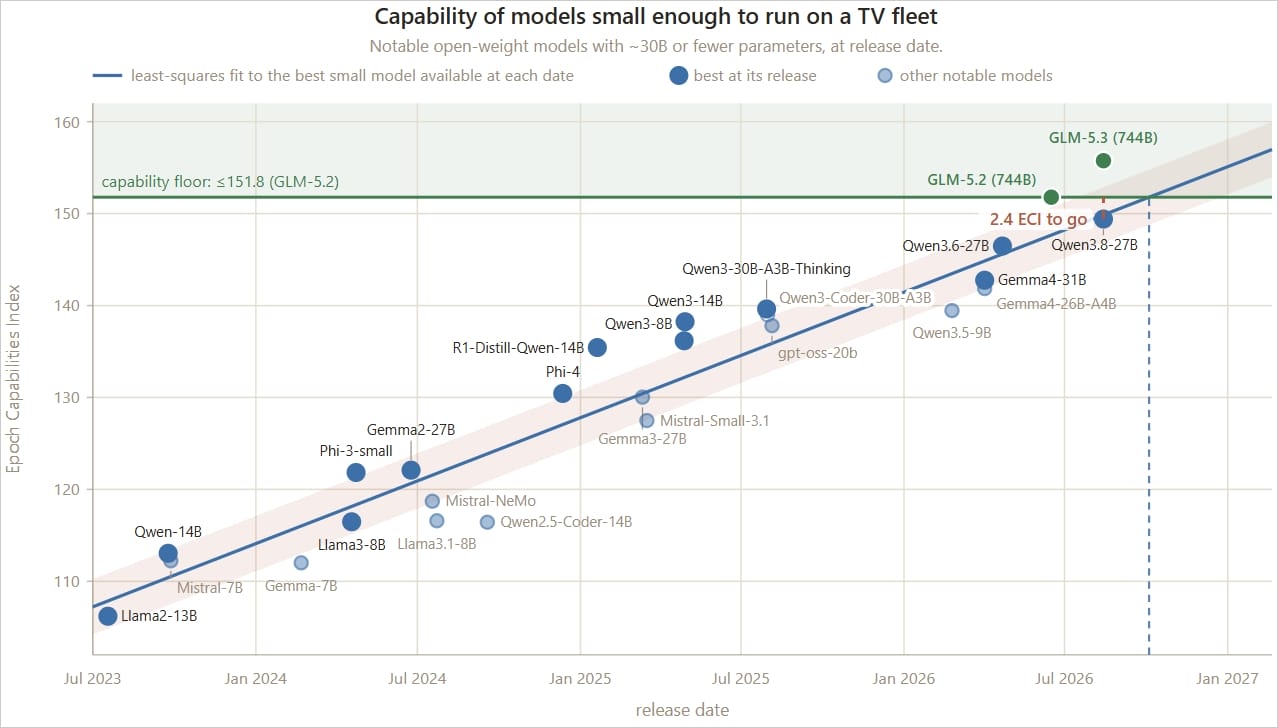
Based on the results and historical progress, Anthropic predicts that models with 30 billion parameters or fewer could be capable enough for self-replication by the end of 2026. That is only a few months away.
Why a self-replicating AI worm is hard to stop
Anthropic describes a replicator like this as challenging to shut down because there is no single point to switch off. It would also be slow. On the tested hardware, setting up inference took 28 to 51 hours for Qwen3.5-9B and 71 to 150 hours for Gemma4-26B-A4B, which gives defenders a wide window to detect the activity. Future models should shrink that window.
For Indian users, the risk lands on the growing pile of cheap smart devices in homes, from Android TV boxes sold without brand support to smart plugs and ovens with weak default passwords. The experiment leaned on open ADB access, so any gadget with exposed debugging ports or unchanged credentials is the realistic target.
What Anthropic suggests for defence
The proposed measures are mostly network level. ISPs and device makers should watch for large model file transfers and unusual device-to-device traffic, run honeypots to inspect payloads, quarantine infected subscribers, and raise the security defaults on IoT firmware. On the user side, turning off ADB when it is not needed and changing default router and device credentials cuts most of the exposure.
Anthropic stresses this is not an imminent threat. The team did not achieve a full end-to-end self-replicating worm even with lowered security settings and explicit propagation goals. The point of publishing the work now is that the capability curve is moving fast enough that IoT security needs attention before the models get there.
FAQ
What is a self-replicating AI worm?
It is an AI system that can copy itself onto other devices, set them up to run a model, and keep spreading without human control. Anthropic’s experiments showed the building blocks but not a working worm.
Which devices are at risk from this kind of AI?
Cheap IoT hardware with weak security, such as off-brand Android TV boxes, smart ovens, and similar gadgets with exposed ADB access or default credentials.
Did Anthropic create a working self-replicating AI?
No. The team spread a model across 15 Android TV boxes in a controlled setup, but did not demonstrate a fully autonomous worm on real consumer hardware.
When could small AI models self-replicate?
Anthropic estimates that models with 30 billion parameters or fewer could reach the needed capability level by the end of 2026 if improvement continues at the current rate.
How can users protect their smart devices?
Disable ADB and unused services, change default credentials, keep firmware updated, and watch for unknown devices joining your home network.
