



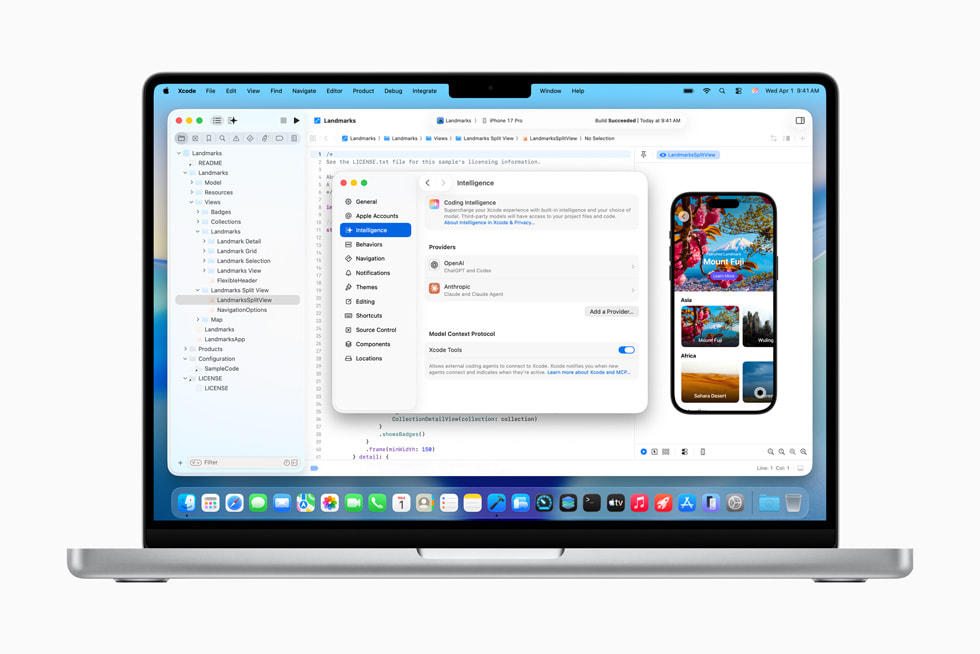
Apple released Xcode 26.3 with support for agentic coding, a new workflow where coding agents like Anthropic’s Claude Agent and OpenAI’s Codex work inside Xcode to complete development tasks autonomously. The release, available as a release candidate for Apple Developer Program members, builds on the intelligence features Apple introduced in Xcode 26.
What Agentic Coding Changes
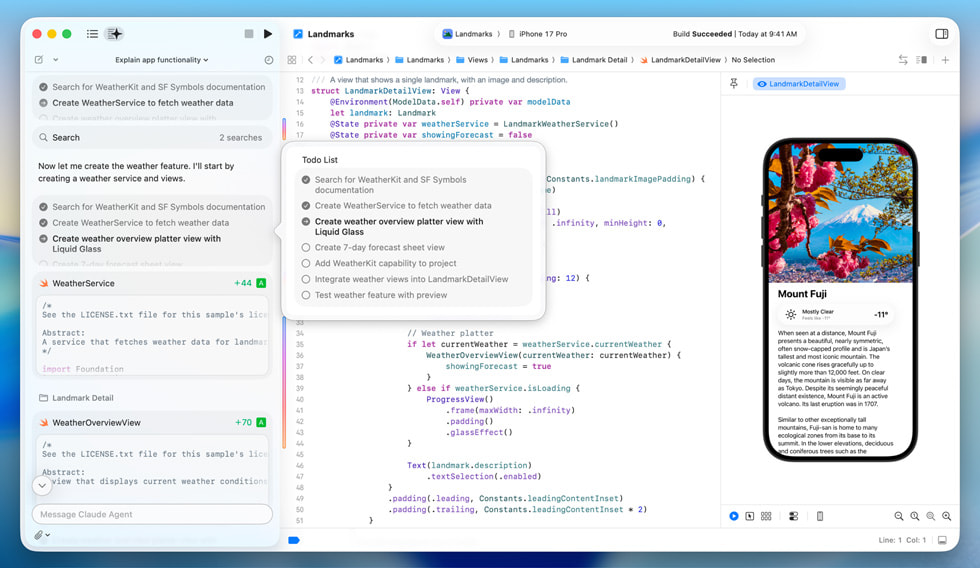
With agentic coding, Xcode gives coding agents access to its built-in capabilities: searching documentation, exploring file structures, updating project settings, and verifying work visually by capturing Xcode Previews. Agents can iterate through builds and fixes without developer intervention for each step.
“Agentic coding supercharges productivity and creativity, streamlining the development workflow so developers can focus on innovation,” said Susan Prescott, Apple’s VP of Worldwide Developer Relations.
Unlike autocomplete-style suggestions, agentic coding agents break down tasks into subtasks, make decisions based on the project architecture, and use Xcode’s native tools to validate their output. A developer can describe a feature and the agent handles implementation, testing, and iteration.
Claude Agent and Codex Integration
Xcode 26.3 ships with native integrations for both Anthropic’s Claude Agent and OpenAI’s Codex. Developers choose which agent fits their project, and the agent operates within Xcode’s sandbox with access to the same debugging and preview tools a human developer would use.
Both agents connect through Xcode’s native capabilities, which means they produce code that follows Apple platform conventions, uses appropriate frameworks, and generates previews that render correctly in the IDE.
Model Context Protocol Support
Beyond the built-in integrations, Xcode 26.3 exposes its capabilities through the Model Context Protocol (MCP). This open standard lets developers plug in any compatible agent or tool, not just Claude or Codex. If you prefer a different model or a custom agent built on MCP, Xcode 26.3 supports it.
What This Means for iOS Developers
For developers building iOS, macOS, watchOS, or tvOS apps, this is a shift in how work gets done. Instead of writing every line manually or accepting autocomplete suggestions, developers can describe intent and let agents handle the scaffolding, debugging, and iteration cycles.
The practical impact depends on how well the agents handle Apple-specific frameworks like SwiftUI, Core Data, and UIKit. Early reports from developers using the release candidate suggest Claude Agent handles SwiftUI layout tasks well but struggles with complex Core Data migrations. Codex shows stronger performance on Objective-C projects but less fluency with the latest Swift concurrency features.
Xcode 26.3 is available now for Apple Developer Program members, with a general App Store release expected in the coming weeks.
Frequently Asked Questions
What is agentic coding in Xcode 26.3?
Agentic coding lets AI agents like Claude Agent and Codex work inside Xcode to complete development tasks autonomously, including searching docs, exploring code, updating settings, and verifying builds.
Which AI agents does Xcode 26.3 support?
Xcode 26.3 has native support for Anthropic’s Claude Agent and OpenAI’s Codex. It also supports any agent compatible with the Model Context Protocol (MCP).
Is Xcode 26.3 free?
Xcode 26.3 is free to download from the App Store. It’s currently available as a release candidate for Apple Developer Program members, with a public release coming soon.
Can I use my own AI model with Xcode agentic coding?
Yes. Xcode 26.3 supports the Model Context Protocol, an open standard that lets developers connect any compatible AI agent or tool to Xcode’s agentic coding workflow.
