



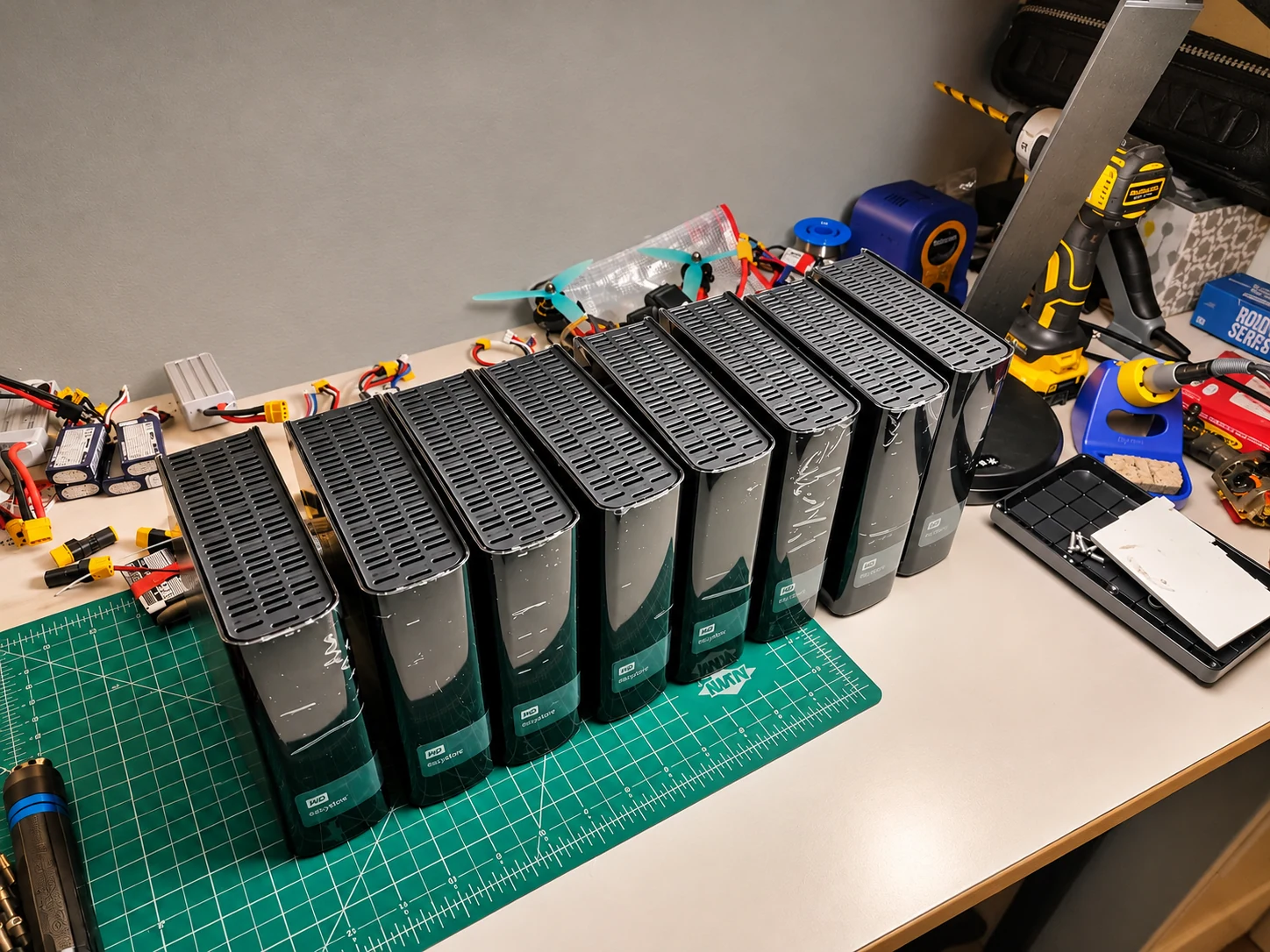
The 20TB WD EasyStore cost $249.99 on Black Friday in November 2024. This Black Friday, the same drive from the same store is listed at $549.99. A homelab blogger’s price tracking has gone viral on Hacker News this week because it puts hard numbers on what storage buyers already suspect: hard drive prices have gone bad, and the usual escape routes are closing too.
The Same Drive, Three Prices
Self-hosting writer ktz, who runs around ten physical disks and replaces a couple every Black Friday, dug up eight years of receipts. The per-terabyte cost of his external drive purchases reads like a chart of the entire industry:
- November 2018: five 10TB WD EasyStores at $179.99 each, $18.00 per TB
- October 2020: 12TB at $174.99, $14.58 per TB
- November 2021: 14TB at $199.99, $14.29 per TB
- May and August 2022: 14TB at $249.99 and $239.99, $17.86 and $17.14 per TB
- October 2023: three 18TB drives at $199.99 each, $11.11 per TB, the best haul on record
- November 2024: 20TB at $249.99, $12.50 per TB
- May 2025: the same 20TB at $279.99, $14.00 per TB
- November 2026: the same 20TB listed at $549.99, $27.50 per TB
That is more than double the 2024 per-TB rate for an identical SKU. The 2026 “deal” for one 20TB drive is fifty dollars short of what three 18TB drives cost in 2023. And if you think dropping to a smaller size helps, the counter example is brutal: Best Buy’s 8TB Black Friday special is $299.99, which works out to $37.50 per TB and fifty dollars more than the entire 20TB drive cost two years ago.
Refurbished Enterprise Drives Are Not a Way Out
The classic budget move is skipping consumer externals and buying recertified or refurbished enterprise drives from specialists like ServerPartDeals. In August 2024, ktz bought four recertified 14TB WD Ultrastars for $529.96 before tax: 56TB at $9.46 per TB, cheaper than the EasyStores and no enclosure shucking required.
The 2026 listings tell a different story. The tracked prices, from the same seller:
- WD Ultrastar HC530 14TB 4Kn: $129.99 to $204.99, up 58 per cent per TB. Sold out.
- WD Ultrastar HC530 14TB 512e: $134.99 to $429.00, up 218 per cent per TB. Sold out.
- Seagate Exos X20 20TB: $235.94 to $589.00, up 150 per cent per TB. In stock, at a price that makes it a last resort.
- Seagate Exos X22 20TB: $224.99 to $649.00, up 188 per cent per TB. Sold out.
Across the board, prices are up a minimum of 58 per cent and in the worst case more than tripled, while availability collapsed. When even the refurbished channel is sold out at record prices, there is no discount aisle left to hide in.
Why This Is Happening
Follow the listings back to the manufacturers and the reason shows up fast: there are only three big hard drive makers left. That level of consolidation, which mirrors the equally strained memory market, makes it hard to read the pricing as anything other than an industry with no pressure to compete on price.
The revenue mix explains who the customers really are. Western Digital’s fiscal 2026 revenue was around 89 per cent cloud business, by ktz’s reading. Buyers picking up two drives for a home server are rounding error. Consumers get what is left after the data centre orders are filled, at whatever price the market will bear.
What makes this round different from the usual supply squeezes is the timing. The same drives are on sale this month as “Black Friday specials” at double last year’s price, a discount against nothing.
What Indian Buyers Should Do
The global price spike has not skipped India, and the rupee maths makes it sharper. When a 20TB external costs $549.99, that is over Rs 48,000 before shipping and customs. Practical moves for anyone planning storage in this market:
- Price per TB, every time. A “sale” tag means nothing without the per-TB calculation. The cheap-looking 8TB deal above is the clearest example of why.
- Do not oversize your NAS plan. Jumping from ten drives to five 20TB units is a sound consolidation idea, but the per-drive cost makes the maths harder than it was in 2024.
- Check local and enterprise channels first. Authorised enterprise resellers and server pull-outs sometimes lag consumer price hikes by a few months.
- Consider holding. If your current drives are healthy, refreshing at 2x the historical price per TB is optional. The tradition of buying a drive every Black Friday assumes a deal exists.
- Use cloud storage for the cold stuff. At current per-TB prices, paying for a few months of object storage while waiting out the spike is easier to justify than it used to be.
- Beware grey-market imports. When domestic stock runs thin, warranty-less imports fill the gap. A drive with no service path is a data risk, not a bargain.
The NAS Maths Nobody Wants to Do
The raw drive price is only part of the sting. Storage planning assumes parity drives, and the price per usable terabyte gets worse once you set one aside. Four 20TB drives cost $999.96 at the November 2024 price. This week, the same four drives cost $2,199.96. That is an extra $1,200 before a case, a motherboard or a single stick of RAM enters the picture.
For home lab users running ZFS or any parity-based layout, consolidation starts to look attractive. Fitting 20TB per slot means going from ten spinners to five without feeling the loss, as ktz notes. The catch is the migration: ZFS does not like layout changes on existing pools, so the shuffle means moving data around and living with a rebuild window. At 2024 prices the hassle was not worth it. At 2026 prices, the calculation flips, and more people will end up doing surgery on their pools just to avoid buying at the peak.
There is also a quiet reliability angle. The discipline of replacing one or two drives a year keeps every disk under five years old. Skipping a refresh cycle because of price feels harmless until a five-year-old drive takes a pool with it. Budgeting for one drive this year instead of two keeps the rotation alive without paying peak pricing on a full rebuild.
FAQ
Why are hard drive prices so high in 2026?
The market is down to three major manufacturers, and demand is driven by cloud buyers rather than home users. Tracked prices show per-TB costs more than doubling since 2024 across both consumer externals and recertified enterprise drives, with several models sold out entirely.
Is the WD EasyStore still worth buying on Black Friday?
Not at current prices, according to the eight-year price history shared on Hacker News. The 20TB model listed at $549.99 this Black Friday cost $249.99 in November 2024. At $27.50 per TB, the old shucking maths that made EasyStores a bargain no longer works.
Are refurbished enterprise hard drives cheaper right now?
The discount has mostly disappeared. Recertified drives at specialist sellers like ServerPartDeals are up 58 to 218 per cent per TB versus 2024, and popular sizes are sold out. One 20TB refurbished Seagate listing remains in stock but at roughly 2.5x its 2024 per-TB rate.
Should I buy hard drives now or wait?
If your current drives are healthy, waiting is reasonable. There is no sign of pricing returning to 2024 levels soon, but buying at the peak of a Black Friday markup is the worst possible entry point. Track price per TB, set alerts, and treat any purchase below the current $27.50 per TB ceiling as the real deal.
