



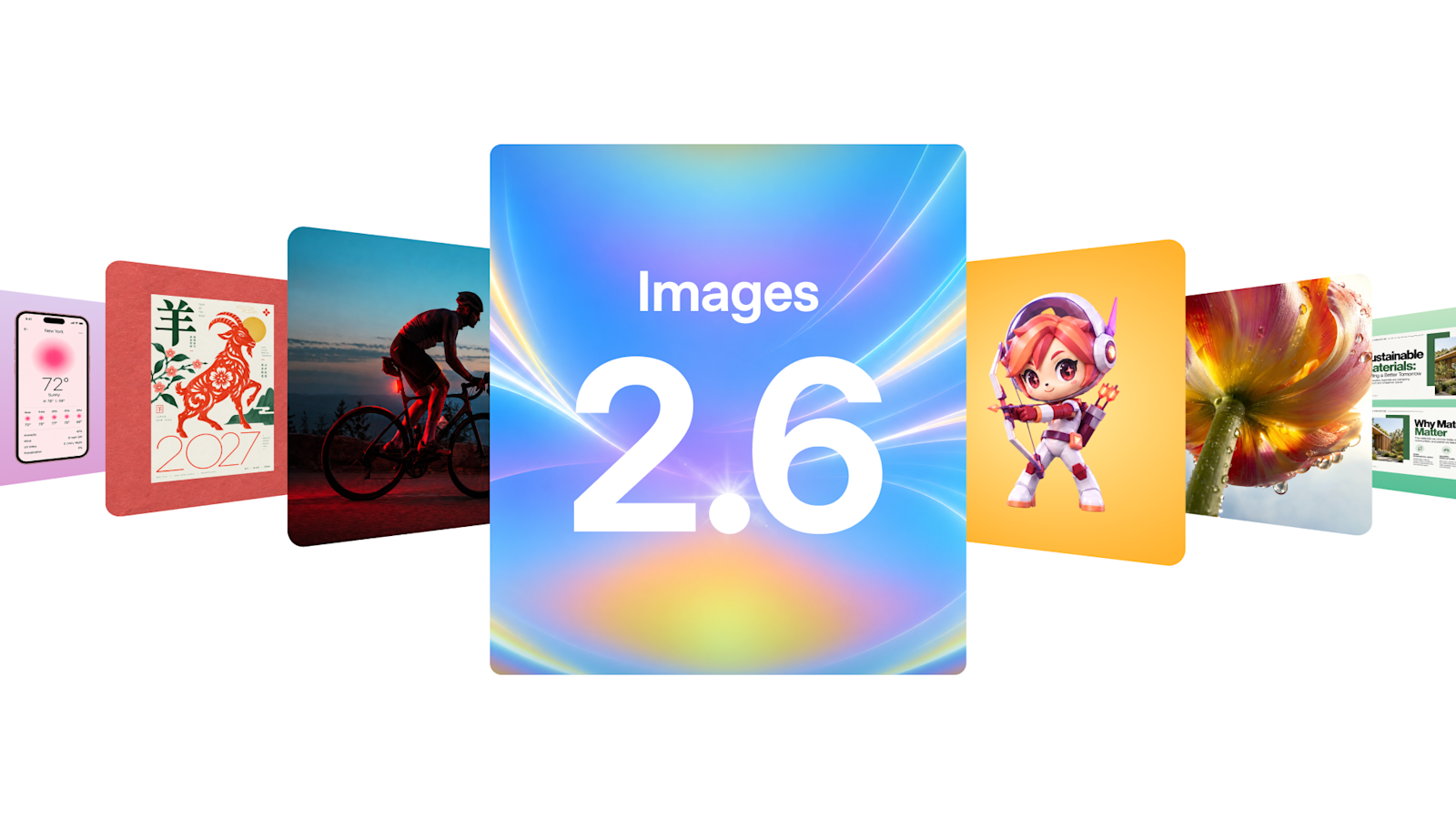
OpenAI shipped Images 2.6 on 4 November 2026, and the headline is speed. The new image model generates pictures 50% faster than the version it replaces, and it can turn them into animated GIFs directly inside ChatGPT, Codex and the API. People now create 4 billion images a week across OpenAI’s products, more than half a billion a day, and the company wants that volume to move faster. Here is everything that changed and what it means if you create visuals for a living.
What OpenAI Announced
Images 2.6 is live in ChatGPT, Codex and the API. OpenAI positions it around three things: faster iteration, GIF animation, and finer control during edits. The company says people create around 4 billion images per week across its tools today, which works out to more than half a billion images per day.
The update also focuses on consistency. OpenAI says the model keeps characters, products and brand details stable across editing rounds, which is the part that usually breaks when you keep tweaking an image in a chat window.
Faster Generation With Flare and Sunburst
In the API, developers now pick between two flavours of the model.
- GPT-Image-2.6 Flare is the speed option. With quality set to low, it can generate an image in as little as six seconds. OpenAI says Flare also improves layout quality for posters, product shots and other professional visuals
- GPT-Image-2.6 Sunburst is the quality option, aimed at work that needs detail and precision. It brings higher-quality output and stronger consistency across edits when quality is set to medium or high
Overall, Images 2.6 generates images 50% faster than before. For anyone iterating on thumbnails, ad creatives or product mockups, that speed change is the difference between a coffee break and a live workflow.
Animate Your Ideas With GIFs
The new GIF support turns still images into short looping animations. OpenAI suggests animating a brand mascot for a campaign, making reaction loops and memes for social media, or building animated storyboards to test movement before committing to video production.
The model can produce a single animation sprite sheet built for a smooth looping GIF, which means the output is ready to drop into a website or a social post without extra tooling. It is not video generation, and it is not meant to compete with Sora. It fills the small-motion gap where a still image feels flat but a full video is overkill.
More Ways to Create and Edit in the API
Developers get three notable additions with this release.
- Image markup comes to the API after being available in ChatGPT. Teams can point at a specific region of an image and request a precise change instead of regenerating the whole thing
- SVG exports make generated designs usable directly on websites, in apps and in print workflows
- A new complexity parameter lets developers control how much planning the model does before generating, trading speed against output polish
OpenAI has published the full details in its pricing and availability section on the release page. The models are available now to anyone using ChatGPT, Codex or the API.
How This Changes Everyday Workflows
For solo creators, the practical change is iteration cost. When a generation takes six seconds instead of half a minute, you explore more options before settling, and the final choice is usually better. The consistency improvements across edits also mean a character or product you designed in round one survives to round five without drifting.
For development teams, the API changes are the bigger story. Image markup turns the model into an editor rather than a slot machine, and SVG export moves generated design work closer to production. The complexity parameter gives teams a dial: low for draft passes, high when the output goes straight into a campaign.
For marketing teams, the GIF support is the part worth testing this week. A looping brand animation used to mean a designer, a timeline and an export step. Now it can be a prompt. That does not replace good design work, but it makes small motion content cheap enough to test on every campaign.
What This Means for Creators and Marketers
Three practical takeaways stand out.
- Batch creative work gets cheaper. Six-second generations at low quality make it realistic to produce ten variants of an ad visual and pick the best one, instead of settling for the first result
- GIF loops are now a native content format. Social teams that already make static brand art can add motion without a video editor
- Brand consistency improves. The stated gains in keeping products and characters consistent across edits matter for anyone who needs the same mascot or bottle across a campaign
The competitive pressure here is real. Google’s Nano Banana image model, Meta’s image tools and a wave of open models have all improved quickly through 2026, and image generation is turning into a commodity feature where speed and control decide which tool people keep using.
Tips to Get Better Results From Images 2.6
- Start with Flare for ideas, finish with Sunburst. Draft at low quality for speed, then regenerate the chosen concept at medium or high quality for the final asset
- Use image markup for fixes. If only the hands or the logo are wrong, point at that region instead of rolling the dice on a full regeneration
- Export SVG when the output is graphic, not photographic. Icons, posters and layout-style visuals scale better as vectors
- Keep prompts consistent across edits. The consistency gains only work if you are not changing the subject description every round
- Try sprite sheet prompts for GIFs. Asking for a single animation sprite sheet built for smooth looping gives cleaner results than asking for a GIF directly
FAQ
What is OpenAI Images 2.6?
Images 2.6 is OpenAI’s latest image generation model, released on 4 November 2026 in ChatGPT, Codex and the API. It generates images 50% faster, supports GIF animation and adds editing controls like image markup and SVG exports.
How is GPT-Image-2.6 Flare different from Sunburst?
Flare is built for speed and can produce an image in as little as six seconds at low quality, with better layouts for posters and product shots. Sunburst is built for detail and keeps images consistent across edits at medium or high quality settings.
Can Images 2.6 create GIFs and videos?
It can create short looping GIFs, including single sprite sheets designed for smooth loops. It does not generate full videos.
Where can I use Images 2.6?
It is available now in ChatGPT, Codex and through the OpenAI API. Developers can also use new controls like the complexity parameter and SVG export in the API.
