



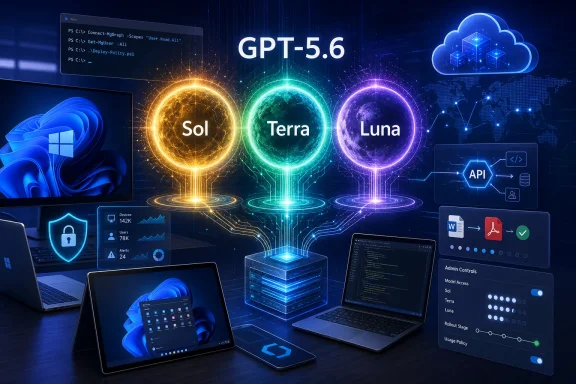
OpenAI announced an 80% price reduction for GPT-5.6 Luna and a 20% cut for GPT-5.6 Terra on July 30, 2026. The move brings the cost of using OpenAI’s most affordable models to a level that makes heavy-volume API usage significantly cheaper for startups and individual developers.
The pricing update applies to the API tier of both models. Sol, the flagship reasoning model, keeps its original pricing for now. The cuts come just three weeks after the GPT-5.6 family moved from limited preview to general availability on July 9.
What the New Pricing Looks Like
Before the cut, Luna was already the cheapest GPT-5.6 option. At 80% off, it now sits well below what most competing models charge for similar capability tiers. Terra, positioned as a GPT-5.5-class model at a lower cost, becomes even more attractive for everyday workloads like document drafting, code completion, and ticket triage.
The pricing shift signals OpenAI’s intent to dominate the mid-tier API market, where Anthropic’s Claude Haiku and Google’s Gemini Flash compete on cost. Developers who previously split workloads between GPT-5.6 Sol for complex tasks and cheaper alternatives for routine jobs may now route almost everything through Luna.
Why the Price Drop Matters

The GPT-5.6 family launched with three tiers: Sol for complex reasoning and coding, Terra for balanced everyday work, and Luna for speed and cost efficiency. Sol scored 7.78% on ARC-AGI-3, outperforming Claude Opus 4.8 (1.5%) and Gemini 3.1 Pro Preview (0.42%) by wide margins.
For context, the original GPT-5.6 Luna pricing was already competitive. An 80% reduction makes it roughly 5x cheaper than it was at launch. Companies running large-scale inference pipelines, chatbots, or content generation systems will see immediate cost savings.
Impact on the AI Pricing Landscape
The price war between OpenAI, Anthropic, and Google continues to benefit developers. Anthropic recently moved Claude Code to usage-based billing on June 1, and Google has been steadily reducing Gemini API costs throughout 2026. OpenAI’s aggressive pricing on Luna and Terra puts pressure on all three competitors to respond.
OpenAI also announced that GPT-5.6 Sol will launch on Cerebras hardware at up to 750 tokens per second in July, adding another dimension to the speed-vs-cost tradeoff. Organizations that need maximum reasoning capability can pay for Sol, while everything else gets routed through the now-dirt-cheap Luna.
FAQ
How much does GPT-5.6 Luna cost after the price cut?
OpenAI reduced Luna’s API pricing by 80% from its July 9 general availability rate. The exact per-token cost depends on your subscription tier and usage volume, but the reduction makes Luna one of the cheapest frontier-class models available.
Did GPT-5.6 Sol get a price cut too?
No. The July 30 announcement only covered Luna (80% reduction) and Terra (20% reduction). Sol pricing remains unchanged.
Can I use GPT-5.6 Luna for coding?
Yes. Luna handles routine coding tasks, script generation, and code review well. For complex multi-step reasoning or large codebase analysis, Sol or Terra may be better choices depending on your budget.
When did GPT-5.6 become publicly available?
The GPT-5.6 family moved to general availability on July 9, 2026, following a limited preview that started June 26 with trusted partners and U.S. government awareness.
