



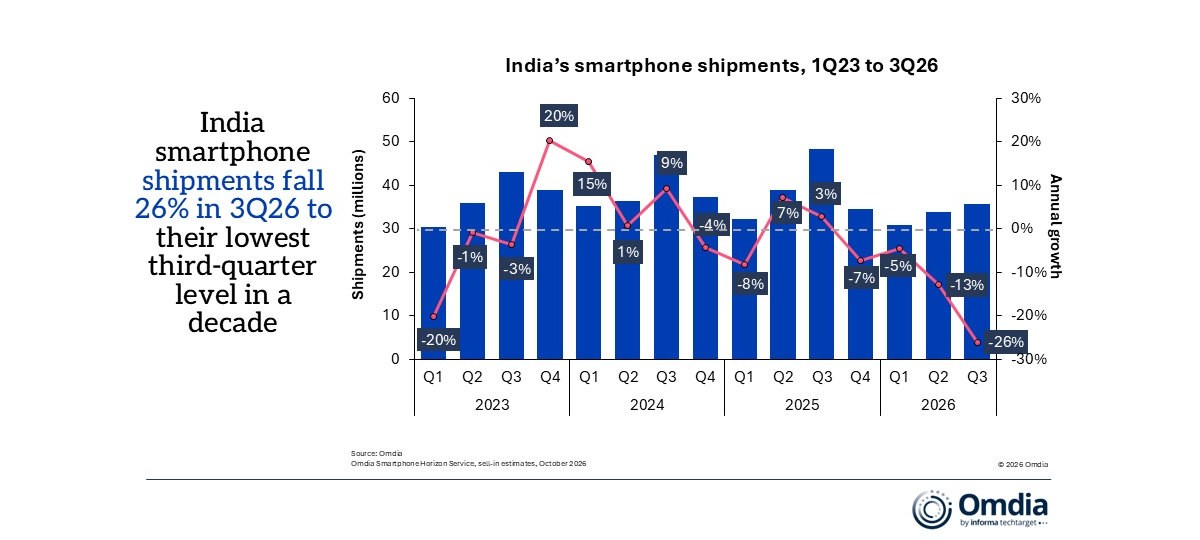
The festive season is supposed to be the strongest quarter of the year for Indian smartphone sales. In Q3 2026 it was the weakest in a decade. Shipments fell 26 percent year-on-year to 35.8 million units between July and September, the lowest third-quarter figure since 2016, according to a new Omdia report.
Higher prices and cautious consumer spending did the damage, and the two feed each other. Here is the full picture, brand by brand, plus what buyers can expect from the rest of the festive season.
The Q3 2026 Numbers at a Glance
- India smartphone shipments fell 26 percent year-on-year to 35.8 million units in Q3 2026.
- It is the lowest Q3 shipment volume since 2016, despite the festive season beginning in the quarter.
- Chinese brands collectively dropped to about 68 percent market share, down from 75 percent a year ago.
- Samsung and Apple both strengthened their positions as the Chinese players stumbled.
Repeated component price hikes pushed retail prices up across every segment. Buyers responded by waiting, holding on to older phones, or dropping to cheaper models. Retailers stocked cautiously too, which cut shipments further even where demand existed.
Who Shipped What: The Brand Standings
Samsung: back to number one
Samsung regained the top spot for the first time since Q1 2024, shipping 6.7 million units for roughly 19 percent of the market. Volume was driven by the Galaxy A07, Galaxy A17, and Galaxy A27 in the mass market, while the Galaxy S26 series, the new foldables, and the Galaxy S26 FE held up the premium end.
vivo: the sharpest fall
vivo slipped to second with 6.4 million units, down 34 percent year-on-year, the steepest decline among the top five. Repeated price hikes disrupted channel inventory planning, and constrained entry-level supplies weakened its line-up. The Y11 5G and Y21 5G carried most of the volume, with the returning S-series, led by the S2, adding some push.
Oppo: steady third
Oppo shipped 4.9 million units, down 24 percent. Rising prices and cautious retailer stocking weighed on the core A-series, while the Reno16 series supported the premium push with camera-led differentiation and financing offers.
Xiaomi: value proposition under pressure
Xiaomi came fourth with 4.7 million units, down 28 percent, as rising component costs ate into its traditional value advantage. The Redmi 15A and Redmi A7 did the volume work, while the Redmi Note 17 series, Poco X8, and Poco X8 Power pushed the higher-value portfolio.
Apple: riding the price-hike wave
Apple rounded out the top five with 3.9 million units. Buyers stocked up ahead of anticipated price hikes, and demand held for the base iPhone 17 and iPhone 16, helped by the absence of a new base iPhone 18. The late-quarter launch of the iPhone 18 Pro and iPhone 18 Pro Max gained momentum on the back of bank cashback, exchange bonuses, and no-cost EMI schemes.
The Channel Story: Online, Offline, and Financing
Shipment numbers also tell a story about how phones are sold in India. When prices rise repeatedly, retailer behaviour changes fast. Shops order less stock, hold fewer variants, and push whatever carries the best margin. That is why entry-level supply tightened even at brands that normally dominate offline shelves.
Financing became the main lever for moving premium stock. Bank cashback, exchange bonuses, and no-cost EMI schemes carried Apple’s late-quarter momentum and helped Samsung’s foldables. The pattern is clear: the sticker price went up, and the effective price got negotiated through financing rather than discounts.
For online-first brands, the quarter was harder. Flash sales and launch discounts do less when the underlying price has climbed, and buyers comparing options online are quicker to delay a purchase than a customer standing in a shop with a working exchange offer.
Why the Indian Smartphone Market Slowed Down
Two forces explain almost all of the decline.
- Prices went up. Component costs rose through the year, and repeated price hikes across brands pushed many buyers out of the market or down a segment. When the same phone costs 10 to 15 percent more than last year’s model, upgrades get postponed.
- Spenders got cautious. Festive discounting normally triggers upgrades. This year buyers waited for bigger deals or held on to devices that still work. Retailers mirrored that caution and stocked less inventory, which shows up in shipment numbers even where sell-through was decent.
The entry-level segment took the hardest hit, which is why brands with heavy budget line-ups like vivo and Xiaomi fell faster than the market average. Samsung and Apple, with stronger premium mixes and deeper offline channels, absorbed the shock better.
What to Expect Next
Omdia expects India’s market to decline by another low-single-digit percentage in 2027, with pricing pressure likely to persist through at least the first half of the year. In other words, the deals are not about to get dramatically better.
There is one lever that might work for brands: AI. Nearly four in ten Indian buyers say useful AI capabilities could make them willing to pay more for a smartphone. Expect marketing around on-device AI, translation, and camera features to get louder through 2027 as vendors try to justify higher prices.
Tips: Buying a Phone This Festive Season
- Buy last year’s flagship over this year’s mid-ranger when prices converge. Older premium models get the biggest festive cuts and still get long software support.
- Use exchange bonuses and bank cashback together. Apple and Samsung offers are stacking these aggressively right now, and the combined discount beats sticker-price cuts.
- Check no-cost EMI terms carefully. No-cost does not mean no processing fee, and the total cost should be compared against a straight purchase.
- Do not wait for a deeper sale if you find a good price. With shipments this low, retailers are running lean inventory and popular variants go out of stock fast.
- If your current phone still gets security updates, holding it another year is a perfectly good choice in a market this expensive.
FAQ
Why did India’s smartphone shipments drop 26 percent in Q3 2026?
Higher prices from rising component costs and cautious consumer spending. Buyers postponed upgrades or bought cheaper models, and retailers stocked less inventory in response.
Which brand sold the most smartphones in India in Q3 2026?
Samsung, with 6.7 million units and about 19 percent market share. It is the first time Samsung has led the Indian market since Q1 2024.
Will smartphone prices come down in 2027?
Probably not soon. Omdia expects another low-single-digit market decline in 2027, with pricing pressure lasting through at least the first half of the year.
Is this a good time to buy a smartphone in India?
Yes, if you stack exchange offers, bank cashback, and no-cost EMI. Prices are higher than last year overall, but festive deal structures are aggressive and stock is limited.
