




Your firewall management server is supposed to be the most protected machine on the network. Between October 17 and November 2, hackers turned that assumption against two dozen Check Point Security Management servers spread across 22 organizations in 17 countries. Threat intelligence firm GreyNoise tracked the campaign as GT13, and its findings show how a single unpatched console can put an entire corporate network at risk.
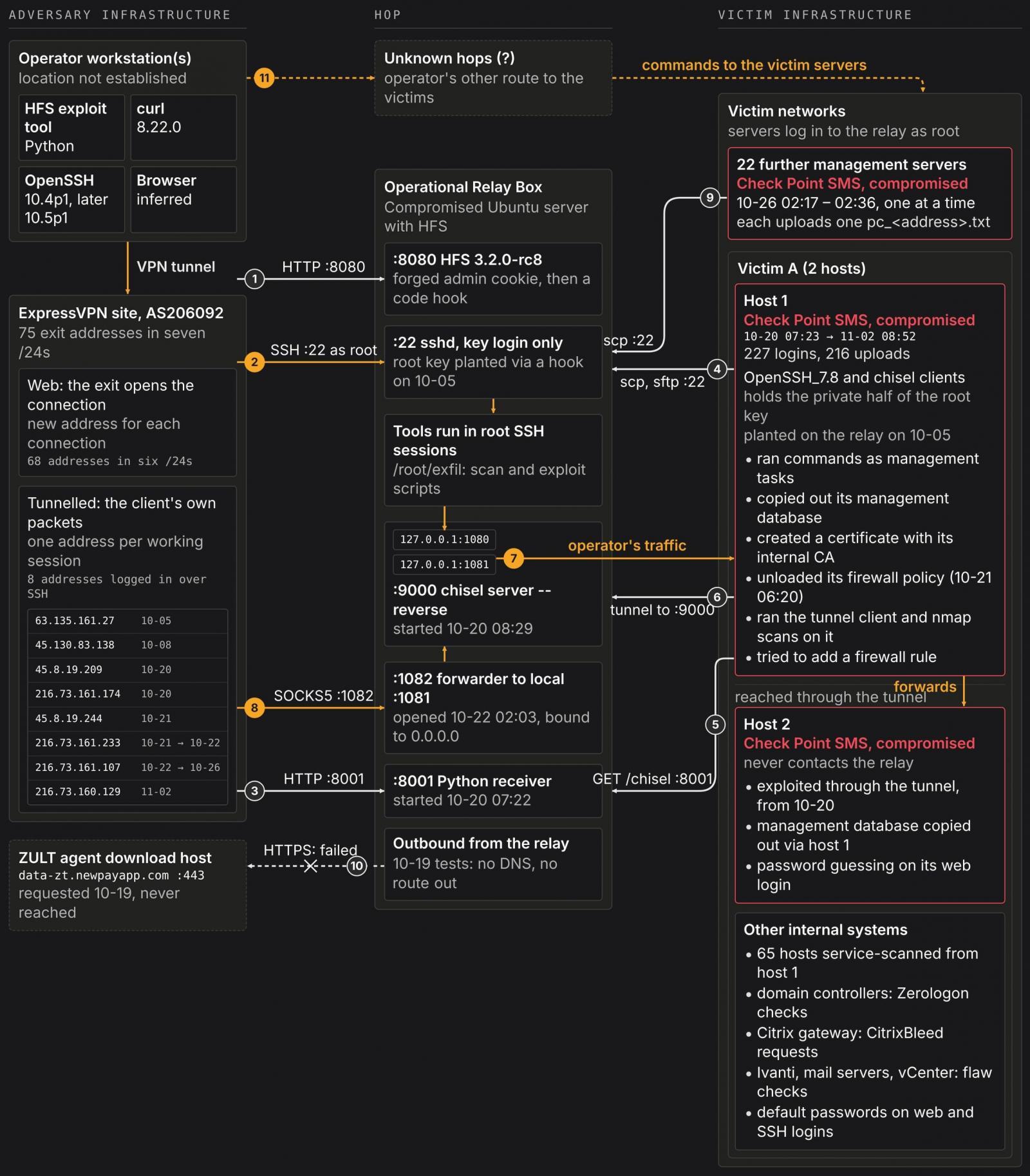
What Happened: The GT13 Campaign in Short
GreyNoise says the activity resembled a cyberespionage operation, though the researchers could not conclusively determine the attacker’s motivation. The victim list offers few clues about targeting. The 22 organizations are spread across 17 countries and include government entities, financial services providers, and companies in the energy, transportation, mining, and manufacturing sectors. There is no clear pattern of who was picked.
Some quick numbers from the investigation, as recorded by GreyNoise:
- 24 Check Point Security Management servers were compromised across the 22 victim organizations
- 99 IP addresses launched the attacks, mostly from compromised Check Point devices themselves and ExpressVPN exit nodes
- Over 1,400 network sessions, 800 command-line artifacts, and 1,200 file-related activities were logged
- A bulk certificate management operation ran across all 24 hacked servers on October 26. The operation failed, but it helped researchers identify the victims
The campaign was still running when GreyNoise’s visibility ended on November 2, and because the attackers held persistent access to the Check Point devices, the researchers believe it may be ongoing. They have notified international government partners and CERTs so impacted organizations can be alerted.
How the Attack Worked
The core of the attack is a Check Point SmartConsole flaw tracked as CVE-2026-16232. It is an authentication bypass: anyone who can reach the console can obtain an application login token and authenticate with administrator privileges, without ever knowing a password. Check Point disclosed the flaw back in July 2026 and flagged it as an actively exploited zero-day at the time.
GreyNoise says the attackers used an adaptation of the publicly available Metasploit module for CVE-2026-16232. In its statement to BleepingComputer on November 25, Check Point confirmed this, noting that the vulnerability and available protections “are therefore not new.”
From there, the operators layered more tools onto the intrusion:
- A Rejetto HTTP File Server, compromised by exploiting CVE-2026-61500, served as an operational relay for managing the intrusions and collecting stolen data
- Post-compromise exploitation of CVE-2026-16232 kept returning admin-level access to the SmartConsole environment
- Attempts against a familiar enterprise toolkit: Citrix NetScaler (CVE-2025-5777, CVE-2023-4966), Ivanti Connect Secure (CVE-2024-21893), Windows NetLogon (CVE-2026-41089, CVE-2020-1472), VMware vCenter (CVE-2021-21972, CVE-2023-34048), Microsoft Exchange (CVE-2021-26855, CVE-2021-34473), and a Linux IPv4 use-after-free (CVE-2026-98432)
GreyNoise could not determine when or how the Check Point servers were first breached. CVE-2026-16232 was observed being used during the post-compromise stages, which leaves open the question of what opened the first door.
What the Attackers Did Inside the Networks
Once inside, the operators went straight for the crown jewels of a security team. The logged activity includes:
- Stealing firewall databases, credentials, configuration data, and internal certificate authority files
- Generating a new certificate in one victim’s environment
- Unloading security policies, effectively switching off the firewall protections for the organization
- Conducting internal network reconnaissance and attempting lateral movement onto other enterprise systems
That is a serious combination. Firewall configuration data maps out the whole network. Internal certificate authority files let an attacker mint trusted credentials. And unloading security policies blinds the defenders while the rest of the attack runs.
One detail caught researchers’ attention. GreyNoise assesses that GT13 operated an AI-powered offensive tool, based on the behaviour, the level of automation, and custom tooling seen in the logs. The company is careful to say that the use of AI in this campaign remains unconfirmed.
Why Security Management Servers Are Prime Targets
This campaign follows a pattern security teams have seen repeatedly. A management server is not just another machine. It holds the central firewall policy for the whole company, the credentials used to push that policy, and often the internal certificate authority that every device trusts. Break into it once and you own the network’s front door and its identity system at the same time.
The GT13 logs show the attackers understood exactly that. They went for firewall databases and certificate authority files first, then tried to unload security policies so monitoring would go quiet. Using other compromised Check Point devices and VPN exit nodes for the attack traffic also shows planning: the operators wanted their scanning and commands to blend in with ordinary enterprise traffic.
For defenders, the lesson is that a management console deserves the same treatment as a domain controller: strict network isolation, multi-factor authentication on every admin session, and alerting on any unusual access.
Tips: How to Protect Your Check Point Setup Today
If your organization runs Check Point Security Management, this campaign is a practical checklist, not just another headline.
- Patch the SmartConsole flaw now. CVE-2026-16232 has been public since July and comes with a working Metasploit module. There is no reason for it to stay open in November
- Audit for Rejetto HTTP File Server. Old HFS installations are a favourite relay tool. If nobody can explain why one is running on your network, remove it
- Review certificates and admin tokens. Look for certificates you did not issue and login tokens issued from unusual IPs. The October 26 bulk certificate operation shows what this looks like in practice
- Watch for policy unloads. A firewall policy suddenly unloading is not routine maintenance. Alert on it
- Rotate credentials exposed to the management plane. Firewall databases and configuration backups contain secrets. Assume they are compromised and rotate
- Pull the GreyNoise indicators. The company has shared indicators of compromise (IoCs) that can identify existing intrusions or block new ones. Match them against your logs
- Segment the management network. Security management consoles should never be reachable from the open internet or from general user networks
FAQ
What is CVE-2026-16232?
It is an authentication bypass in Check Point SmartConsole that lets an attacker obtain an application login token and authenticate with administrator privileges. Check Point disclosed it in July 2026 and marked it as an actively exploited zero-day, and a public Metasploit module exists for it.
Which organizations were hit in the Check Point GT13 campaign?
GreyNoise observed 22 victim organizations across 17 countries, including government entities, financial services providers, and firms in energy, transportation, mining, and manufacturing. The researchers say there is no clear evidence of specific targeting.
Is the Check Point attack campaign still running?
GreyNoise lost visibility on November 2 but believes the campaign could still be ongoing, because the attackers kept persistent access to the compromised devices. International government partners and CERTs have been notified.
Did the Check Point hackers use AI?
GreyNoise assesses that the group operated an AI-powered offensive tool, based on observed automation and custom tooling, but the company states that the use of AI remains unconfirmed.
