



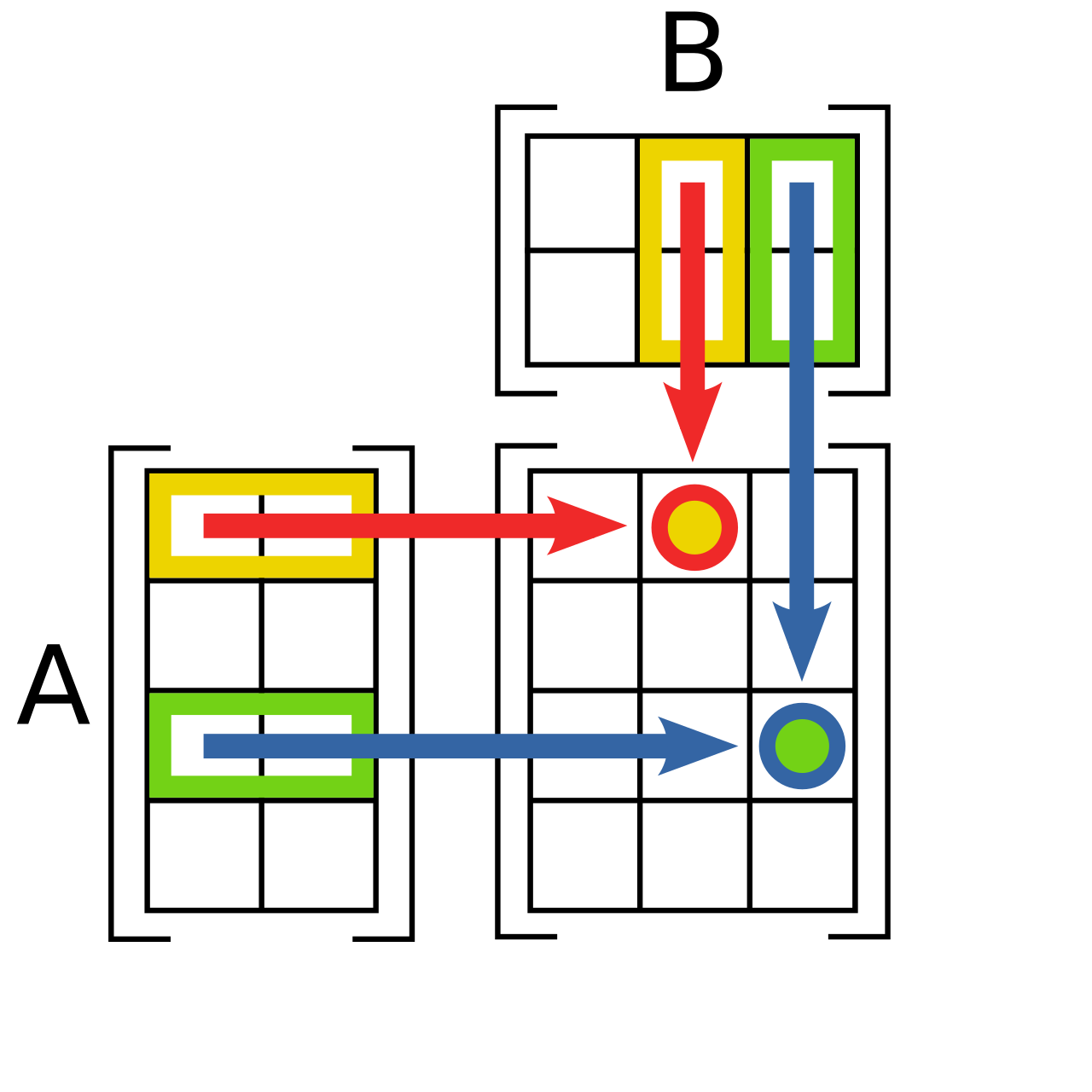
Matrix multiplication is the operation that trains your AI models, renders your games, and runs half of scientific computing. For sixty years, computer scientists have asked a deceptively simple question: what is the fastest possible way to multiply two matrices? On November 24, 2026, a preprint posted to OpenAI’s public math repository on GitHub claimed an exact answer. The paper, titled “The matrix multiplication exponent is nine fourths”, claims the exponent is exactly 9/4, or 2.25, and that it holds over every field. If it survives review, it closes one of the biggest open problems in computer science.

What Is the Matrix Multiplication Exponent?
Multiply two n by n matrices the way you learned in school and you need about n cubed operations. In 1969, Volker Strassen showed you can do better: around n raised to 2.807. That kicked off a long chase. For decades, researchers shaved small fractions off the exponent, and the best known bound has sat just under 2.372 for years, most recently improved to around 2.371.
The exponent, written as the Greek letter omega, is the smallest number such that n by n matrices can be multiplied in n to the power of omega operations. There was even a popular conjecture that omega equals exactly 2. The new preprint claims the true answer is 9/4, and that the old conjecture is wrong.
What the Preprint Claims
According to the paper and the discussion around it on Hacker News, where the story reached the front page within hours, the results include:
- The exact matrix multiplication exponent is 9/4 (2.25), over every field, unconditionally. This refutes the long-standing conjecture that omega equals 2
- The same paper also gives polynomial-time algorithms for strongly polynomial linear programming, which is Smale’s ninth problem, plus mean-payoff games, parity games, and Condon’s simple stochastic games
- It refutes the conjectured polynomial diameter bound for polytopes and the polynomial pivot rule for the simplex method, showing some pairs of vertices are superpolynomially far apart
- A companion paper proves the Erdos-Rado sunflower conjecture bound for every fixed number of petals
Context matters here. These are preprints, not peer-reviewed publications. The work is attributed to models that OpenAI has not released, and the method used to find the results has not been disclosed. On Hacker News, one commenter noted the results came from an unreleased model and that OpenAI “has been doing this kind of thing since August.” Treat every claim above as unverified until the mathematical community finishes checking it.
Why 2.25 Instead of 2?
For years, many researchers assumed the exponent might collapse all the way to 2. The preprint argues it does not. One useful way to think about the gap: as Hacker News commenters pointed out, the result pins down the exact difficulty of multiplying integers, polynomials, and matrices, the first two conditionally and the last one unconditionally. But “unconditionally” comes with a technical footnote: it assumes matrix entries can be multiplied and added in constant time, which is the standard algebraic complexity model.
There is also a practicality gap. As one commenter summarised, the only known solution that reaches the claimed bound is impractical, so in practice we are still roughly n to the power of 0.1 above the theoretical limit. Your phone will not get faster tomorrow.
A Short History of the Exponent
The claim lands in a chase that has run for more than five decades:
- 1969: Strassen’s algorithm shows matrix multiplication can beat n cubed, at about n to the 2.807
- 1987: Coppersmith and Winograd push the bound down to about 2.376
- 2010s: further refinements bring the best known bound close to 2.372
- 2022: DeepMind’s AlphaTensor uses machine learning to discover new multiplication algorithms, another sign of AI entering this field
- 2023 to 2024: incremental improvements settle the bound just above 2.371
- November 24, 2026: the new preprint claims the exact exponent is 9/4, jumping past the incremental tradition entirely
Notice the pattern break. Every entry before 2026 was a small shave. This one claims a closed-form answer, which is why the reaction has been so intense.
Why Everyone Is Talking About AI Doing Mathematics
The reason this story trends beyond maths circles is the source. This is not a lone professor with a proof. It is presented as output of an AI research program, and the community reaction has focused on what that means:
- One popular theory on Hacker News is that OpenAI may be holding back its best models to make fundamental breakthroughs, then using those results to build stronger models in a compounding loop
- Others see open maths problems as ideal training signal: hard, free of contamination, and perfectly verifiable. As one commenter put it, they are a “magic trifecta” for reinforcement learning
- Our own coverage of AI models doing research, including the debate around AI-generated proofs in Lean, shows how fast this space has moved in a single year
Whether or not the proofs hold up, the direction is clear. AI systems are now producing candidate results on problems that top mathematicians have chased for decades, and humans are in the verification loop.
Tips: How to Read Announcements Like This
- Check the venue. A preprint on GitHub is a claim, not a result. Wait for peer review and expert verification
- Look for independent attempts at verification. The real test is whether other mathematicians can follow the proof line by line
- Separate the headline from the detail. “Exact exponent 9/4” and “practical faster algorithms” are different things, and only the first is claimed
- Watch the follow-ups. OpenAI’s repository posts updates. Revisions after scrutiny are normal and healthy
FAQ
What is the matrix multiplication exponent?
It is the smallest power omega such that two n by n matrices can be multiplied in about n to the power of omega operations. The old best known bound was just under 2.372. The new preprint claims the exact value is 9/4, or 2.25.
Is the claim that matrix multiplication is solved proven?
No. It is a preprint posted on November 24, 2026, in OpenAI’s math repository. It has not been peer reviewed, and independent mathematicians are still checking the proofs. The claim is strong; the verification is not finished.
Will this make my computer or AI faster?
Not directly. The result is about the theoretical limit, and the known construction that reaches the claimed bound is impractical. Real-world matrix multiplication will keep improving slowly through engineering rather than this paper.
Which other problems did OpenAI’s new papers address?
Related preprints claim progress on strongly polynomial linear programming (Smale’s ninth problem), mean-payoff games, parity games, simple stochastic games, the simplex method’s pivot rule question, and the Erdos-Rado sunflower conjecture. All remain unreviewed.
