



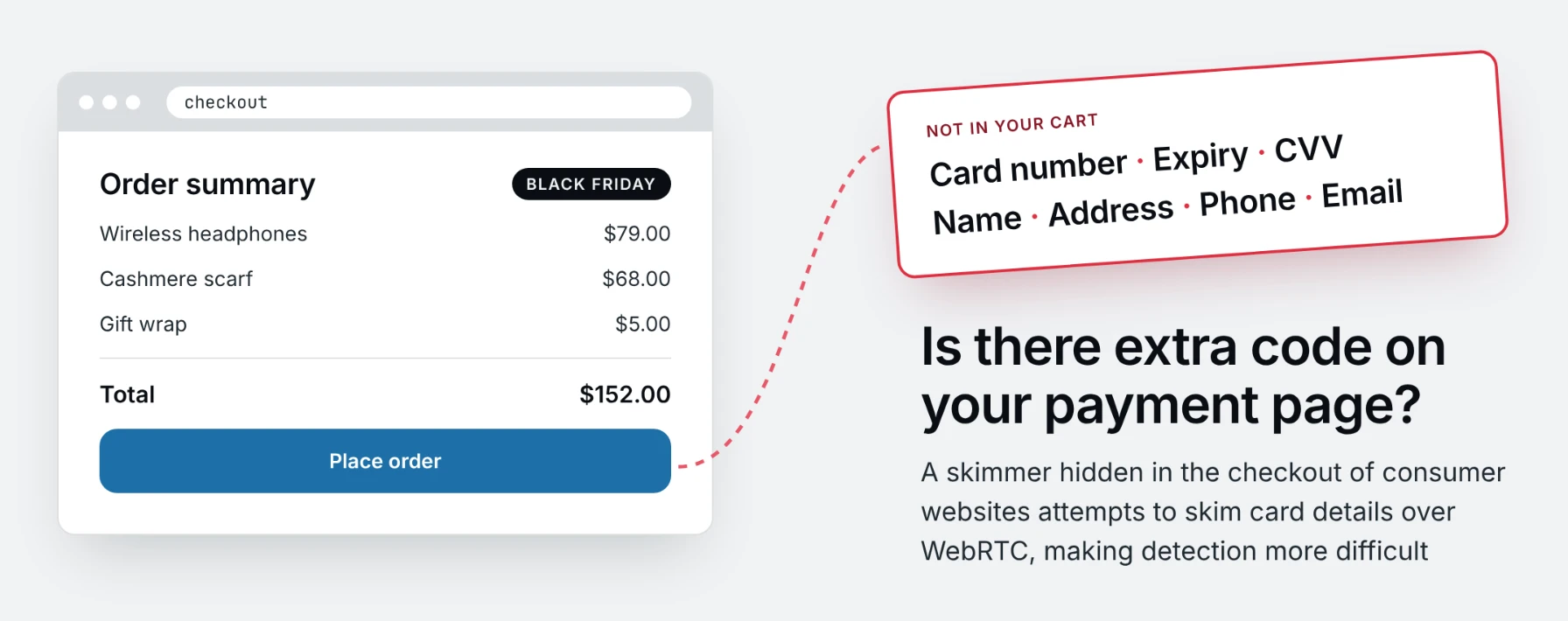
A card-skimming script was planted on the online stores of Lascana, Samsonite, American Tourister, Revolve and FWRD in the week before Black Friday, and it stole payment details over WebRTC, the same browser technology behind video calls. Security researchers at InfoHawk caught the kit in action on one of the five sites and reported it to every affected company. All had the script removed on November 24 or 25, but the attack shows how far skimmers have moved beyond simple injected JavaScript. Here is how the kit works, which stores were hit, and what shoppers and site owners should do now.
Which Shopping Sites Were Affected
InfoHawk found the skimmer delivered through three different routes across five websites run by different companies:
- Lascana (lascana.com): delivered through an altered Quorum marketing pixel. InfoHawk observed the skimmer sending test card details to a third party here. Lascana and Quorum both replied and removed the code on November 24.
- Samsonite (shop.samsonite.com) and American Tourister (shop.americantourister.com): delivered through an edited Seers cookie-banner setting. Neither party replied to researchers, but the code was removed on November 24 at 14:25 UTC.
- Revolve (revolve.com) and FWRD (fwrd.com): delivered through an altered file on Revolve’s own CDN. Revolve confirmed removal on November 25 and said it resolved the issue the same day it was notified.
The script was built to capture a card number, expiry and security code, along with the shopper’s name, address, phone number and email. It grabbed the details before the store checked the payment, so a card could be stolen even if the order was declined or cancelled, and nothing would look wrong to the shopper. Across all five sites, it is not known how many shopper details, if any, were captured before removal.
How the WebRTC Skimmer Works
Most card skimmers inject a script that sends stolen data out through a normal web request. This one is different. It uses WebRTC, the technology that lets a web page open its own connection to another party and pass data over it. Security monitoring tools often watch this channel less closely than ordinary web traffic, and WebRTC can relay through infrastructure that looks like everyday call traffic.
InfoHawk’s breakdown of the kit shows seven stages:
- 1. Bootstrapping: the loader gets onto the store page through a consent-banner setting, a retailer CDN file, a shared marketing pixel or the store’s own HTML.
- 2. Loading scripts: it pulls in a file named Insds.js or gtage.js from an Amazon S3 bucket.
- 3. Targeting: it runs only on small or touch screens. The Samsonite version ran on checkout pages only, so desktop checks and homepage scans would likely not see it.
- 4. Establishing the connection: a GET request to /_cf/ice fetches relay details, and a POST to /_cf/rel sends the WebRTC offer to a look-alike host, northbridgeads[.]com. This is the one step an ordinary web request handles, and a Content Security Policy connect-src rule can block it.
- 5. Data exchange: every exchange that returned relay details used turn.cloudflare.com, so the traffic blends in with normal WebRTC relay traffic and hides its true endpoint.
- 6. Code delivery: the skimmer arrives in chunks over the WebRTC data channel, is checked against a SHA-256 digest, then runs.
- 7. Data theft: the captured card details travel back over the same data channel. At Lascana’s checkout, researchers captured exactly this happening with a test card.
Steps 5 to 7 run outside the reach of connect-src rules, which is what makes this delivery method awkward to defend against with a single header. Blocking step 4, though, stops the attack before the skimmer ever arrives, whichever file was tampered with.

Why This Keeps Happening
Each of the five sites loaded third-party code it did not write and could not fully control. A marketing pixel, a cookie-consent widget and a CDN file all became attack surfaces because whoever controls those files can change them without the retailer noticing. The code runs with the same rights as the site’s own scripts: it can read the page, watch what users type and load more code.
The timing is not a coincidence either. A similar weakness was exploited at scale on November 16, 2026, when attackers reportedly used a flaw in Optimizely’s Web Experimentation product to add malicious code to customers’ projects. Optimizely’s own servers delivered it to visitors of 178 organizations’ sites, including Zoom, the BBC and CNN, with no change to those sites’ own code. Checkout pages that load the same marketing tags as the rest of the site are the common thread in both incidents.
What Shoppers Should Do This Black Friday
- Check your statements now: look for charges you do not recognize, especially on debit cards. Credit card liability for unauthorized charges is capped at $50 under US federal law and is generally zero if only the card number was stolen. Debit card protections depend on how quickly you report, so act fast.
- Report fraud immediately: call your bank or card issuer, report the charge and ask for a new card number. Follow up with a written dispute within 60 days of the statement showing the charge.
- Prefer credit cards for online orders: the chargeback protections are stronger and the money is not gone from your account while the dispute runs.
- Use virtual card numbers: many banks and card apps issue single-merchant card numbers, which limits the damage if a checkout page is compromised.
- Be suspicious of mobile checkout behaviour: this kit targeted phones and tablets. If a checkout page feels slow or reloads oddly on mobile, open the same cart on a desktop browser before paying.
What Site Owners Should Do Immediately
InfoHawk’s guidance for retailers is short and specific:
- Set a connect-src rule on every page that takes payment: list only the hosts you use. That blocks the two web requests the skimmer needs before WebRTC opens.
- Search for the loader: check page source, tag managers, consent-banner settings and CDN files for scripts from brand-static.s3.amazonaws[.]com, specifically the files Insds.js and gtage.js.
- Audit tracking pixels: if you load qscripts.s3.amazonaws[.]com/pscript.js, check its last line for one of those CDN buckets.
- Check Seers banner configs: in the affected configurations, the privacy-policy link field also held a hidden image whose onerror handler loaded the malicious code. Every URL field in cdn.seersco.com banner configs should hold only a URL.
- Hunt the indicators: the strings KghRtc, rtc-signal-v1 and quickfetch appear in the malicious code. On a phone-sized touch screen at the payment step, look for /_cf/ice and /_cf/rel requests to northbridgeads[.]com.
- Keep third-party tags off payment pages: card fields should sit in an isolated payment frame. Every pixel on a checkout page is code someone else can change.
FAQ
What is a WebRTC credit card skimmer?
It is a card-skimming script that loads malicious code and sends stolen payment details over WebRTC data channels instead of ordinary web requests. Because WebRTC traffic is often relayed and monitored less closely, the theft blends in with normal browser activity.
Were Lascana, Samsonite or Revolve hacked before Black Friday?
A skimming script was found on Lascana, Samsonite, American Tourister, Revolve and FWRD in the week before Black Friday 2026. It entered through third-party tools such as a marketing pixel and a cookie-banner setting, not through the stores’ core systems. All five had it removed on November 24 or 25.
How do I know if my card was skimmed online?
You usually cannot tell from the checkout page itself. Review recent card statements for unfamiliar charges, especially small test charges, and report anything suspicious to your bank right away to get a replacement card number.
How can online stores prevent checkout skimmers?
Set a strict Content Security Policy connect-src rule on all pages that take payments, keep third-party marketing tags off checkout pages entirely, and audit every pixel, consent banner and CDN file that can run script on payment steps.
