



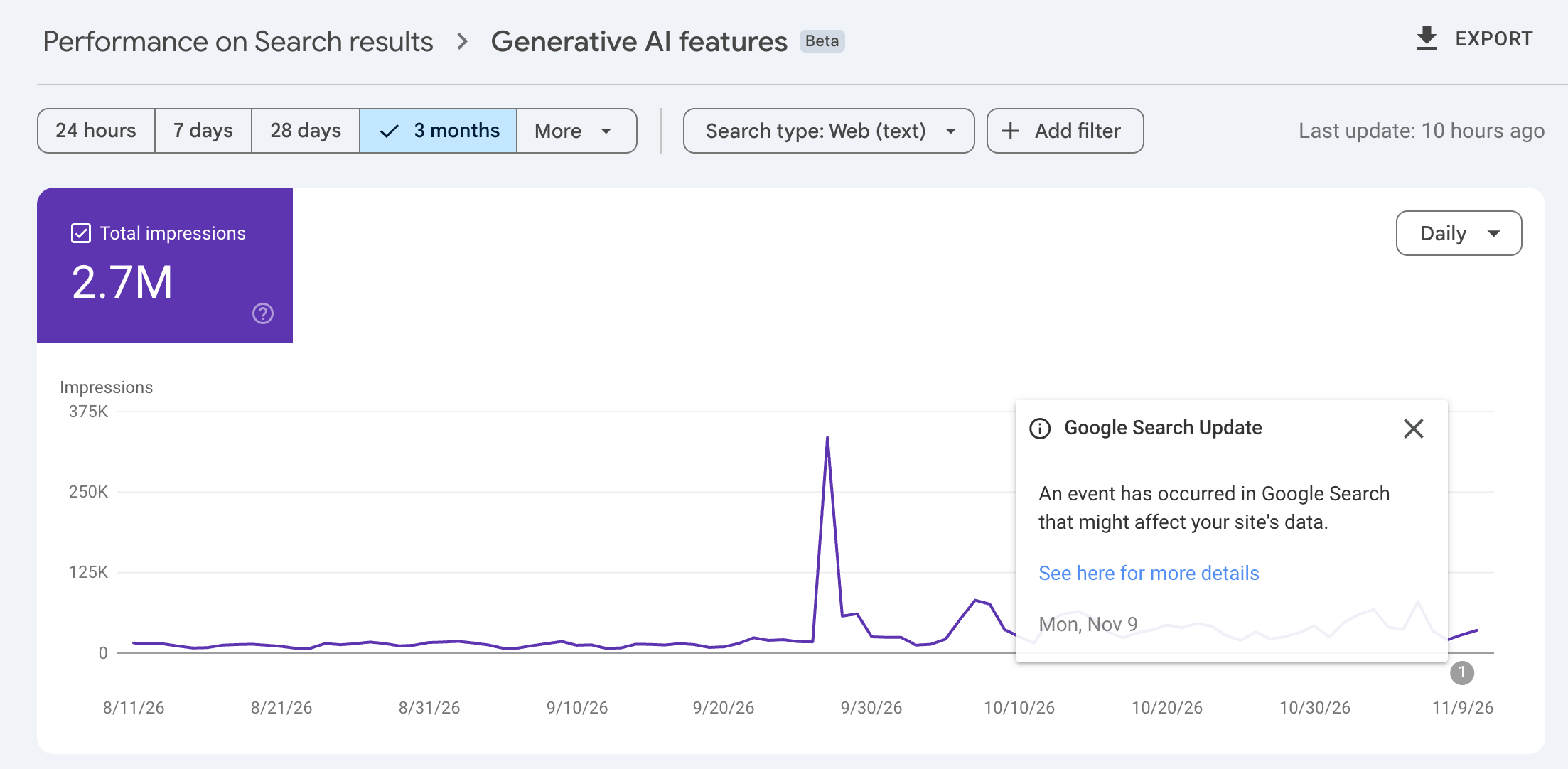
If your Google Search Console numbers looked strange this week, you were not imagining it. Google has confirmed a logging error in the Generative AI performance report in Search that caused a drop in reported impressions for data between 9 November and 11 November 2026. The dip is a reporting bug, not a traffic problem. Here is what happened, what to check, and how to explain it to clients.
What Exactly Happened
A day after Google began rolling out the November 2026 core update, a data logging bug appeared in the Search Console Generative AI performance report. Google’s own notice in the report states:
Google: “A logging error caused a decrease in impressions on the Generative AI performance report in Search for data from November 9 to November 11, 2026. This issue affects data logging only.”
The problem was first flagged by Barry Schwartz at Search Engine Land on 12 November, and Google has since added a warning notice inside the affected report itself. Three days of data in the AI-focused reporting view is undercounted because impressions were not logged correctly.
What the Bug Does and Does Not Affect
This is the part most people get wrong. The bug touches reporting, not performance.
- Affected: impression counts in the Generative AI performance report in Search Console for 9 to 11 November 2026.
- Not affected: your actual visibility or clicks in AI Mode and AI Overviews. Google states the issue affects data logging only.
- Not the same report as: the classic Search performance report, which covers the familiar blue-link results.
In plain terms, your site may have appeared in far more AI search results during those three days than the report shows. The data is incomplete, not the traffic.
Why the Timing Is Awkward
The bug landed in the middle of a Google core update rollout, which is the worst possible moment for bad data. Core updates already shake up rankings across search results, and marketers spend weeks carefully comparing before-and-after numbers to judge their impact.
That creates a double trap:
- Real ranking shifts from the November 2026 core update can hide inside the reporting gap.
- Apparent impression drops in AI reports can be blamed on the core update when the cause is a logging error.
- Weekly and monthly comparisons that include 9 to 11 November will be skewed for AI search reporting.
Anyone doing impact analysis for this core update needs to treat those three days as incomplete data and say so in their write-up. The same rule applies to client dashboards, agency reports and any AI visibility scorecards that pull from Search Console for that window. A one-line note now saves a confusing conversation in December, when month-over-month comparisons start rolling in.
How to Check Your Own Data
A quick audit takes a few minutes and gives you clean numbers to work with:
- Open the Generative AI performance report in Search Console and look for Google’s notice about the data issue.
- Compare report views. Check the classic Search performance report for the same dates. If it looks normal while the AI report dips, the bug explains the gap.
- Cross-check with analytics. Your own analytics tool counts sessions, not Google impressions. If sessions held steady between 9 and 11 November while AI impressions fell, nothing was actually wrong.
- Use the API if you report on it. Data pulled through the Search Console API comes from the same logging pipeline, so expect the same gap and note it wherever those numbers appear.
- Annotate the dates. Mark 9 to 11 November as a known data issue in your reporting dashboards so future comparisons do not misread the dip.
Do the check once this week and again after Google updates the report. If Google backfills the missing impressions, your charts will change retroactively, and you want to know when that happened.
How to Explain This to Clients and Stakeholders
Most client panic comes from charts without context. A short, direct note prevents a week of back-and-forth.
Something like: “Google confirmed a logging error that undercounted impressions in its AI search reports between 9 and 11 November 2026. Our actual visibility was not affected, and the dip is a reporting artifact. We have annotated the dates and will not use those three days in trend comparisons.”
Keep three habits through this period:
- Separate reporting bugs from performance changes. Confirm with Google’s own notices before reacting to any sudden drop.
- Do not make optimisation changes based on incomplete data. Three days of missing impressions is not a reason to rewrite content or pull back spend.
- Document everything. Core update analysis published later should note both the update rollout and the reporting gap as separate events.
None of this requires new tooling. It is the same reporting discipline that every algorithm update deserves, applied to a bug fix that happens to sit on top of one.
What Marketers Should Do Next
With the core update still rolling out and AI reporting unreliable for three days, the sensible move is patience plus measurement discipline.
- Track rankings and clicks, not just impressions, through the core update window.
- Watch the AI search reports weekly rather than daily until the data settles.
- Compare week-over-week, not day-over-day, and exclude the gap days from any trend line.
- Wait for Google to correct or backfill the historical data before drawing conclusions from that period.
Why AI Search Reporting Is Worth Watching Anyway
The Generative AI performance report is still relatively new, and this bug underlines why it deserves careful handling. Impressions inside AI surfaces such as AI Mode and AI Overviews work differently from classic search. An impression can mean your brand was cited, summarised, or shown as a source link, and the click-through behaviour on those surfaces is still being studied across the industry.
That makes clean data essential. Teams doing generative engine optimisation work use these reports to judge whether their content gets picked up by AI answers at all. A three-day logging gap in the middle of a core update can easily produce a false conclusion about whether AI visibility is rising or falling. Keep tracking it, but treat it as an early signal rather than the final word, and always pair it with referral data in your analytics.
Quick Takeaway
- Google confirmed a logging error that undercounted impressions in the Generative AI performance report from 9 to 11 November 2026.
- It is a reporting bug only. Real visibility in AI Mode and AI Overviews was not affected.
- The gap overlaps the November 2026 core update rollout, so annotate it in every impact analysis.
- Cross-check with your analytics before believing any impression dip from those dates.
FAQ
What is the Google Search Console data bug from November 2026?
Google confirmed a logging error that caused a decrease in reported impressions on the Generative AI performance report in Search for data between 9 and 11 November 2026. Google states the issue affects data logging only.
Did the Search Console bug affect my actual traffic?
No. The bug only affected how impressions were logged in the AI performance report. Your real performance in AI Mode and AI Overviews was not impacted, so traffic and clicks from those surfaces are unaffected.
Should I ignore the November 2026 core update while this is fixed?
Do not ignore it, but do treat 9 to 11 November AI impression data as incomplete. The core update rollout is a separate event, and real ranking shifts during that period still deserve attention.
How do I report this to my clients?
Tell them plainly that Google undercounted impressions in its AI search report for three days because of a logging error, that actual visibility was unaffected, and that you have excluded those dates from trend analysis. Annotate the same note in your dashboards.
