




AI is now writing a large share of the code that makes AI better. That is the headline finding of a new independent assessment by METR, the AI safety research organisation, which spent 11 weeks inside Anthropic looking at how the company builds its models. The result: Anthropic’s models are improving roughly twice as fast as they were a year ago, and a majority of that speed-up appears to come from Anthropic using its own AI systems for research and development. Here is what METR measured, what it could not show, and why researchers are unsettled.
What METR Was Doing Inside Anthropic
From 12 August to 29 October 2026, METR staff ran a high-access evaluation at Anthropic to measure one question: to what degree is AI accelerating AI research and development? The question matters because if AI systems start meaningfully speeding up the development of even better AI systems, progress could compound quickly and reach capabilities nobody has evaluated.
Anthropic gave what METR describes as unprecedented access to internal data on its R&D process. That included metrics on pretraining and reinforcement learning, training compute in each domain, benchmark scores for internal models, internal AI speed-up analyses, forecasts for a future model’s metrics, and interviews with staff. The assessment is separate from the programme that gives safety researchers “employee-like” access to systems, which was set up after a string of AI security incidents over the summer.
The report was published on 5 November 2026 on METR’s blog. One condition of the engagement: Anthropic had the right to redact non-public information from the final report, and METR says it exercised that right on a majority of the evidence that METR found most informative.
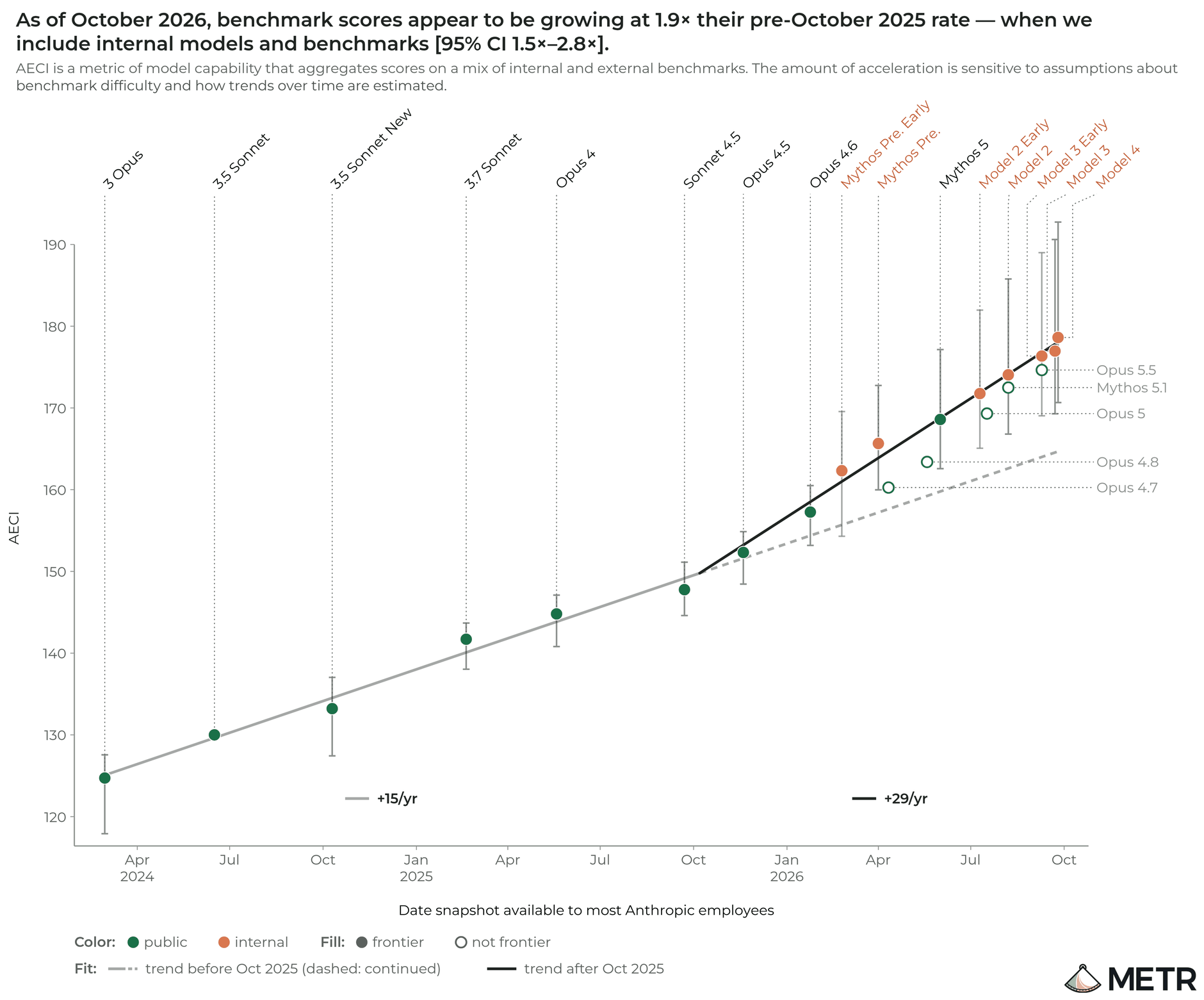
Key Findings: 1.9x Faster Benchmark Growth
The most quoted number in the report is this: since October 2025, benchmark scores for Anthropic’s models have grown at an estimated 1.9 times the rate they did before, with a 95 percent confidence interval of 1.5 to 2.8 times. METR measures this with AECI, which is Anthropic’s internal version of the Epoch Capabilities Index. Put simply, the assessment says Anthropic has made roughly two years of historical progress in the last year.
METR’s overall conclusion is slightly broader: Anthropic is likely improving its models’ capabilities on well-specified tasks at around twice the rate it managed between March 2024 and October 2025. The researchers attach high uncertainty to this, and say they “would not be surprised” if the true figure were closer to 1.3 times or 3 times.
- Acceleration is real: about 2x the historical rate of capability improvement, with wide error bars.
- AI usage is the main driver: METR believes a majority of the speed-up is attributable to Anthropic’s extensive use of AI for R&D, though other causes played a large role in late 2025.
- Not just more chips: the team is confident the acceleration did not come from faster scaling of training compute. The growth is algorithmic and process-driven.
- Assistance first, autonomy next: staff report that R&D is accelerated mainly by AI assistance today, but METR saw signs that fully autonomous contributions will play a larger role soon.
- No visible ceiling: METR did not find evidence of significant bottlenecks in algorithmic progress, training compute, experiment compute or data that would slow progress over the next 12 months.
That last point is the one researchers keep coming back to. If there are no bottlenecks and no diminishing returns in view, the same feedback loop could push progress even faster from here. METR itself hedges: its understanding of the bottlenecks changed several times as more detailed information arrived, so the team is not confident in its own assessment of them.
Why the Redactions Concern Researchers
Anthropic’s redaction rights cut both ways. The company described the redactions as “aimed at removing confidential information that could accelerate other AI developers”, which is a reasonable business position. But METR notes bluntly that Anthropic redacted a majority of the evidence the researchers found most informative for their risk conclusions, and that some redactions are hard to even describe without revealing what they hide.
The practical effect, in METR’s words, is that the public cannot judge the evidence itself and has to rely on METR’s judgment “much more than would be ideal”. Some of the highest-level risk conclusions were shareable in full. Much of what backs them was not.
There is also an awkward tension in the timing. Anthropic is preparing to go public, with its S-1 filed, at the same moment its CEO Dario Amodei has publicly called for AI labs to pump the brakes on development. The METR findings show the company’s internal research pace doubling, driven by the very automation Amodei warns about.
What This Means for AI Development
Read plainly, the report is the clearest public evidence yet of AI accelerating its own development. A year ago this was a theoretical worry. Now a safety organisation with 11 weeks of inside access says a frontier lab is compressing two years of model progress into one, mostly by putting its own models to work on research.
Three practical takeaways:
- Expect faster model cycles. If internal benchmarks keep compounding at this rate, the gap between releases will keep shrinking.
- Evaluation is now the bottleneck. Capabilities are improving faster than the outside world can assess them, especially when evidence is redacted.
- Watch the autonomy shift. AI-assisted research is here now. The move to fully autonomous contributions, which METR sees signs of, is the step that changes the risk picture.
FAQ
What is the METR report on Anthropic?
It is an independent assessment published on 5 November 2026 by METR, an AI safety research organisation, after an 11-week high-access evaluation inside Anthropic from August to October 2026. It measures how much AI is accelerating Anthropic’s own AI research.
How fast are Anthropic’s models improving?
Anthropic’s benchmark scores have grown at an estimated 1.9 times the pre-October 2025 rate (95 percent confidence interval 1.5 to 2.8 times), which METR says amounts to roughly two years of historical progress in one year. The headline estimate is about twice the historical rate of capability improvement.
Why did Anthropic redact parts of the METR report?
Anthropic had contractual redaction rights and described its use as aimed at removing confidential information that could accelerate other AI developers. METR says a majority of its most informative evidence was redacted, which limits how much the public can independently verify the conclusions.
Does this mean AI development is out of control?
Not yet, but METR found no significant bottlenecks that would slow progress in the next 12 months, which raises the risk of further acceleration. The report is a warning about the pace of progress, not a claim that anything has gone wrong.
