



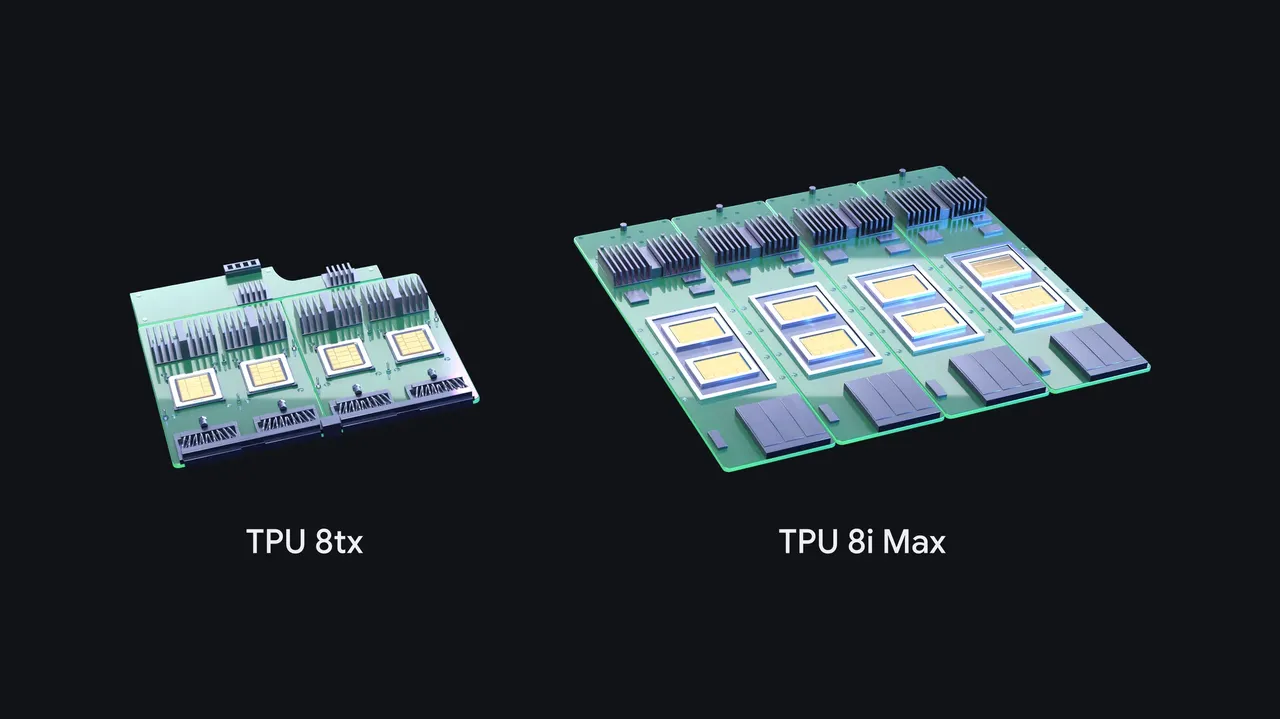
Google just keeps making its own AI chips. On 9 November 2026 the company unveiled TPU 8tx and TPU 8i Max, two new additions to its eighth-generation tensor processing unit line. That makes four new TPU systems from Google in a single year, and the latest pair targets two very specific problems: training models on sensitive data, and handling huge amounts of memory during queries.
Here is what each chip does and why Google is pushing deeper into silicon.
TPU 8tx: Confidential AI Training
TPU 8tx is designed with AMD and builds on the TPU 8t that Google launched in April 2026. The focus is confidential computing for AI. Google says the chip “builds security directly into the hardware layer, keeping sensitive data and model weights protected and isolated even while in active use”.
What that means in practice:
- Train on private data without moving it. Banks, hospitals and governments can fine-tune models on their own data while keeping that data encrypted and isolated during training.
- Reasoning alongside training. The chip has a custom inferencing network that can run inference jobs while training continues. Google says this lets companies distil and train smaller models on the fly.
- Model weights stay protected. Even administrators cannot peek at the weights while the model is running.
The AMD collaboration is notable. Google is leaning on AMD’s chip design experience here rather than building every variant fully in-house, which speeds up delivery for these specialised parts.
TPU 8i Max: Double the Memory
TPU 8i Max takes a simpler approach. It combines two of the inference-focused TPU 8i chips into a single package, which doubles memory capacity, processing power and bandwidth compared with one TPU 8i.
The benefit is straightforward. Models can work with a larger range of information during queries. Think longer documents, bigger retrieval contexts and more complex agent workflows, all without splitting work awkwardly across chips. For teams running large reasoning models in production, memory is usually the wall they hit first, so doubling it in one package is a meaningful upgrade.
Why Google Keeps Designing Its Own Chips
Every major cloud provider is now doing the same thing. Microsoft announced its own AI inference chip earlier in 2026, Amazon started selling its AI chips directly, OpenAI unveiled a custom chip built with Broadcom, and Anthropic has been hiring its own chip design team. The common goal is reducing dependence on Nvidia, whose GPUs still dominate AI infrastructure.
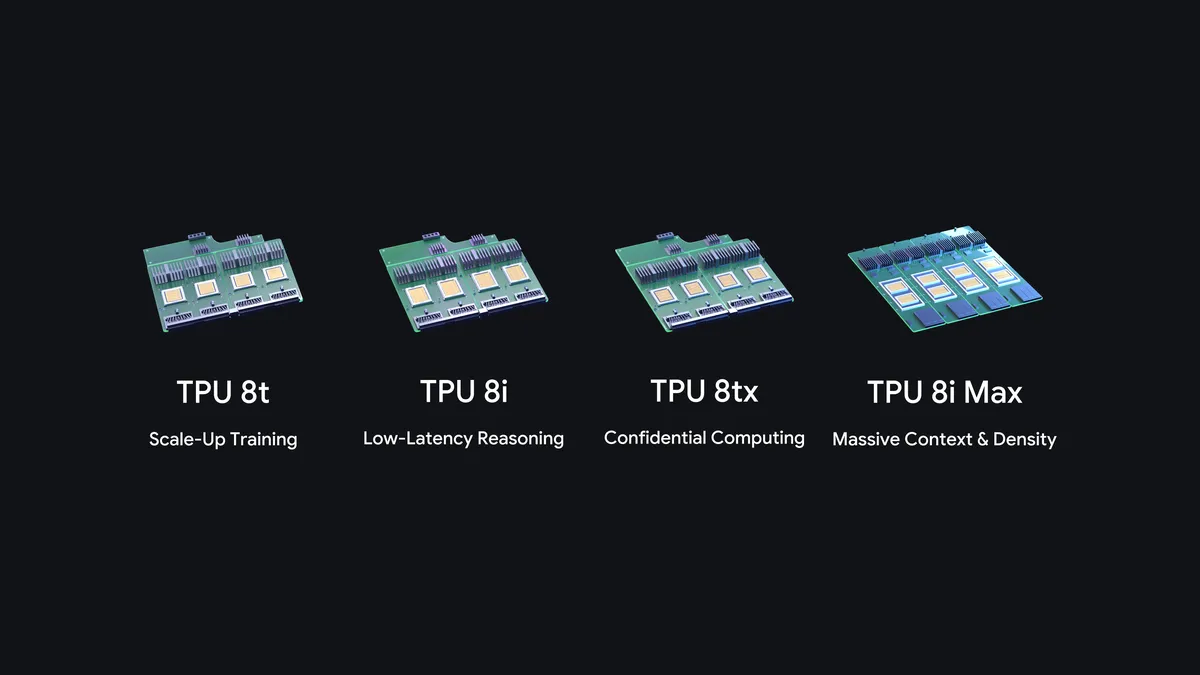
Google has the longest head start. The company has been building TPUs since the mid-2010s, and the eighth generation alone now covers general training (TPU 8t), inference (TPU 8i), confidential workloads (TPU 8tx) and memory-hungry queries (TPU 8i Max). Four systems in one year is a pace that GPU roadmaps are struggling to match.
A Short History of Google’s Eighth-Gen TPUs
This generation has moved fast. Google introduced the original eighth-generation parts at Google Cloud Next in April 2026, positioning them against Nvidia’s data centre GPUs for both training and inference. Seven months later the line has grown to four systems: TPU 8t for training, TPU 8i for inference, TPU 8tx for confidential workloads and TPU 8i Max for memory-heavy queries. Each variant keeps the same software stack, so code written for one generation ports over without a rewrite.
What Confidential Computing Actually Means
The term gets used loosely, so it is worth pinning down. Confidential computing keeps data encrypted while it is being processed, not just while it sits in storage or moves across a network. On TPU 8tx, the data and the model weights are decrypted only inside a protected area of the chip. The operating system, the cloud hypervisor and the administrators who run the servers cannot read the contents.
That closes the last of the three states of data: at rest, in transit and now in use. For a hospital fine-tuning a diagnostic model on patient records, or a bank tuning fraud models on transaction logs, this removes the last excuse for copying sensitive data into less protected environments.
What This Means for Google Cloud Customers
- More choice of shapes. You can now match the workload to the chip instead of squeezing everything onto one type.
- Confidential AI is becoming real. Regulated industries have been waiting for hardware that keeps training data isolated. TPU 8tx is aimed squarely at that gap.
- Longer contexts, lower cost. TPU 8i Max’s doubled memory should help per-query costs for large models by keeping more work on one chip.
- Availability. Google has not published per-chip pricing. Access will run through Google Cloud, and enterprise customers can ask their account teams for availability in their region.
Tips for Teams Watching This Space
- If you handle regulated data, look at confidential computing options on every cloud now, not just Google’s. This is the direction the industry is moving.
- Memory limits are the real bottleneck for agent workloads. Check your current inference chips’ memory before assuming you need more compute.
- Do not over-commit on hardware. Chip options change fast in this market. Prefer flexible contracts while roadmaps are this active.
Frequently Asked Questions
What are Google’s new TPU 8tx and TPU 8i Max chips?
They are two new variants of Google’s eighth-generation TPU line, announced on 9 November 2026. TPU 8tx focuses on confidential training and inference, while TPU 8i Max doubles memory capacity for large-query workloads.
What is special about TPU 8tx?
It protects sensitive data and model weights at the hardware layer during use, and its custom inferencing network can run reasoning while training continues. Google designed it with AMD.
How is TPU 8i Max different from TPU 8i?
TPU 8i Max packs two TPU 8i chips into one package, doubling memory, processing power and bandwidth, so models can handle more information per query.
Why is Google building its own AI chips?
To reduce dependence on Nvidia and other chip suppliers, and to tailor silicon to specific AI workloads. Microsoft, Amazon, OpenAI and Anthropic are all pursuing similar chip programmes.
