



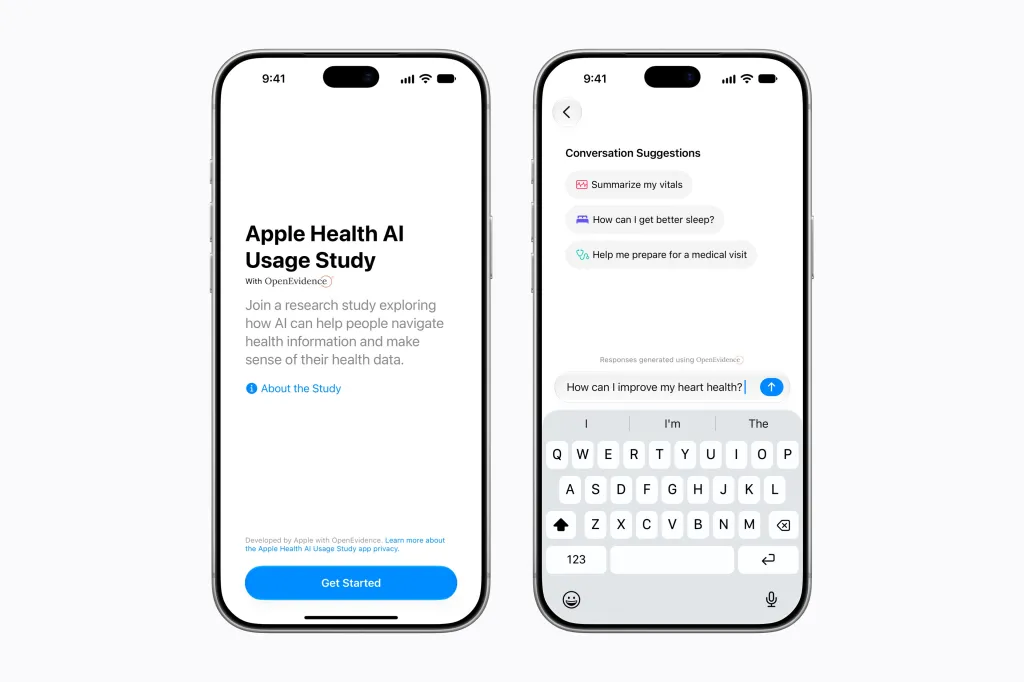
People are already asking AI chatbots millions of health questions every week. OpenAI said earlier this year that users send it over 300 million health-related queries a week. Apple now wants to study what happens when those answers come from clinically grounded sources instead of a general chatbot. On 15 November 2026, Apple launched a study app built with healthcare AI company OpenEvidence, and it is inviting up to 200,000 people in the US to take part for more than a year. Here is what the app does, who can join and what Apple is really after.
What the Apple Health AI Study App Is
The new app is a research study first and a product second. It lets participants ask health-related questions and get answers grounded in clinical data from sources like The New England Journal of Medicine, the Journal of the American Medical Association and Nature. The answers are written in simplified language so everyday medical questions get everyday explanations.
The study is a partnership with OpenEvidence, a healthcare-focused AI company that builds clinical question-answering tools for doctors. Apple is not launching a consumer health chatbot yet. It is running a study to understand how people engage with, comprehend and evaluate health AI in everyday life, and the app is the instrument for that research.
Who Can Join the Study
Apple has set clear eligibility rules, and the study is limited to the US for now:
- You must be in the United States and over 21
- You need an iPhone 15 or later
- Your phone must run iOS 26 or later
- Apple Intelligence must be enabled on the device
The app is available to download now for eligible users. Apple aims to run the study with up to 200,000 participants over more than 12 months, so the sample size is far larger than a typical medical research panel.
How the App Works
The core loop looks like a chatbot, with a few research-specific additions:
- Ask a health question. You type it the way you would ask ChatGPT or Claude, whether it is about a symptom, a medication or a lab result.
- Get a clinically grounded answer. The response is built on clinical literature rather than general web text, then simplified for a non-specialist reader.
- Rate the answer. Participants give feedback on the responses they get, which is one of the main data points the study is collecting.
- Complete monthly surveys. Participants are also asked to fill in surveys each month about their experience and expectations.
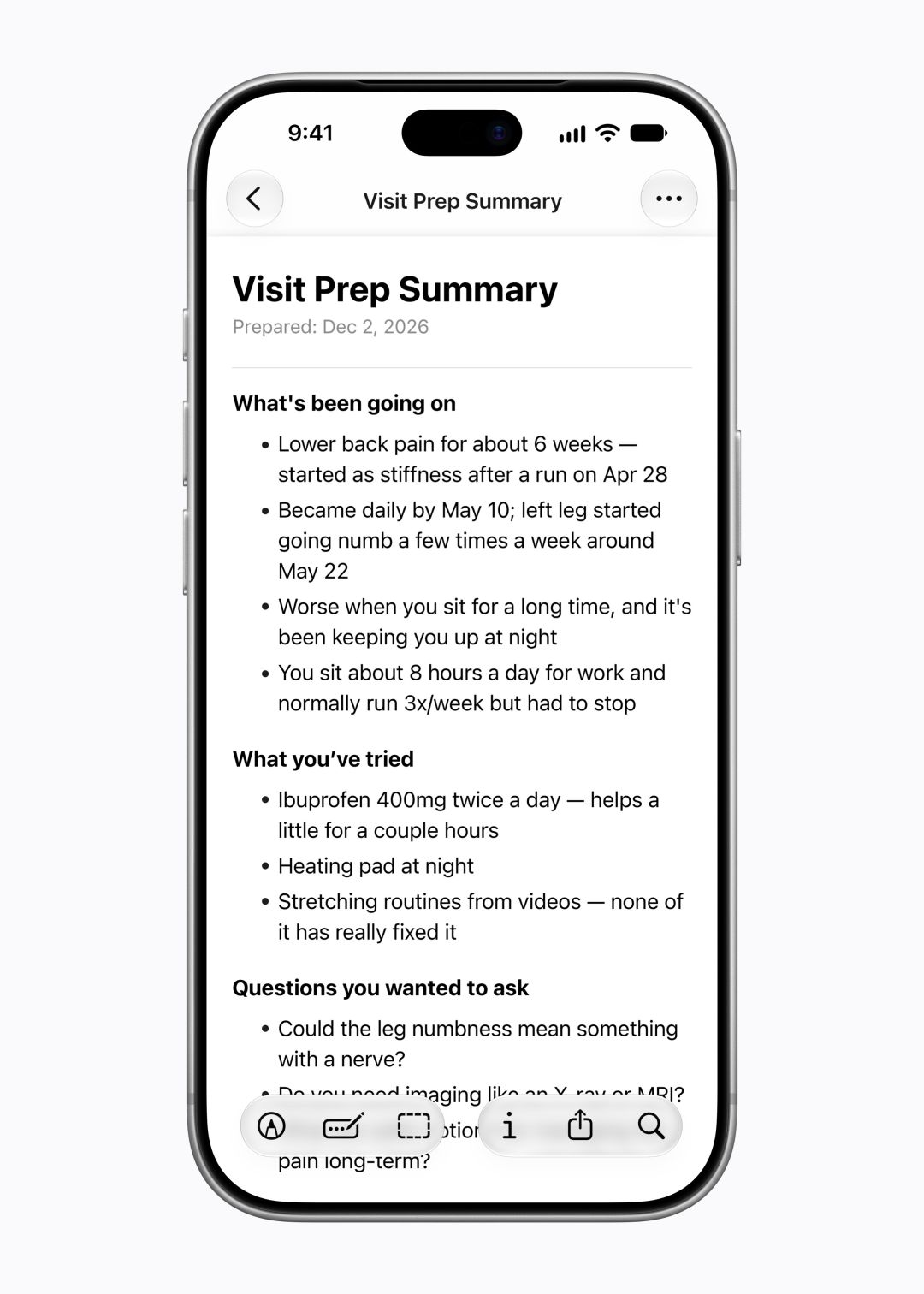
Two features go beyond plain question answering. First, participants can choose to share data from HealthKit, such as resting heart rate, activity, sleep or lab results, which lets the app give more personalized and pointed suggestions. Second, the app can help participants prepare for a doctor’s visit, and it will guide users to specific providers when a question touches on something medically concerning.
How Apple Handles the Privacy Questions
Health data is the most sensitive category on a phone, and Apple’s announcement leans heavily on the safeguards:
- Study data is anonymized before it leaves the device, then sent to a secure third-party cloud provider
- The data will not be used to train any AI models
- OpenEvidence deletes query and response data after 24 hours
- HealthKit sharing is optional and controlled by the participant
Sumbul Desai, M.D., Apple’s vice president of Health and Fitness, framed the study as a deliberate step rather than a product race. “At Apple, we believe responsible innovation starts with scientific rigor and clinical grounding,” she said in a statement, adding that health is deeply personal and a dedicated research study is the most thoughtful way to understand how people engage with health AI.
Why Apple Is Studying Instead of Shipping
Every big AI lab is pushing health features. OpenAI and Anthropic both ship chatbots with specialised health capabilities, and OpenAI’s query numbers show the demand is already there. Apple’s move is different in shape. Rather than adding a health chatbot to Siri or the Health app today, it is collecting evidence on how clinically grounded answers land with real users.
The company has not said whether the study will turn into a consumer feature. It is not clear yet whether AI-powered answering will arrive in the Health app or Siri. But the direction of travel is easy to read: if the study shows that people understand and trust clinically grounded answers, Apple will have both the data and the partner to ship one.
For users, the practical takeaway is simple. If you have ever typed a symptom into a chatbot at midnight and wondered where the answer came from, this study is the industry’s first large-scale attempt to test answers built on peer-reviewed medicine instead.
What This Means for Users Outside the US
The study is US-only for now, and Apple has not said anything about expanding it to other markets. For readers in India and elsewhere, the practical effect is indirect but real. The findings will shape how Apple builds health AI features worldwide, and the privacy pattern being tested here, anonymised data, no model training and 24-hour deletion, is the kind of design regulators in other markets will ask for when these features eventually ship.
There is also a competitive angle. If Apple’s study shows that people trust clinically grounded answers more than general chatbot answers, every health AI product will be expected to name its sources. That pressure reaches apps sold everywhere, not just in the US.
For India specifically, the gap the study points at is already visible. Health questions are among the most common queries people send to chatbots in every market, and the answers vary wildly in quality. A result that shows sourced answers work better would give Indian health apps and telehealth platforms a clear design target: name the journal, show the guideline, and say plainly when a question needs a doctor instead of a chat window.
Tips for Anyone Using AI for Health
- Check what the answer cites. Grounded tools name their sources. A response that references journals or guidelines is easier to verify than one that does not.
- Share health data deliberately. Features like HealthKit sharing improve personalisation, but switch on only what you are comfortable with.
- Use AI to prepare, not to diagnose. The study app itself guides users to providers for concerning issues, which is the right pattern: use AI to organise questions, then take them to a doctor.
- Watch the deletion policy. Tools that delete query data on a short schedule, like the 24-hour window OpenEvidence uses, keep less history at risk.
What is the Apple health AI study app?
It is a research app from Apple and OpenEvidence that lets participants ask health questions and get answers grounded in clinical sources like The New England Journal of Medicine. Apple launched it on 15 November 2026 to study how people use and understand health AI.
Who can join the Apple health study?
US residents over 21 with an iPhone 15 or later running iOS 26 or later and Apple Intelligence enabled. Apple plans to enrol up to 200,000 participants for a study lasting more than 12 months.
Is my health data safe in the study?
Apple says study data is anonymised before being sent to a secure third-party cloud provider, will not be used to train AI models, and OpenEvidence deletes query and response data after 24 hours. HealthKit data sharing is optional.
Will Apple add health AI answers to Siri or the Health app?
Apple has not announced anything. The company says it is not clear yet whether the study will lead to AI-powered answering in the Health app or Siri, and the research is meant to inform that decision.
